
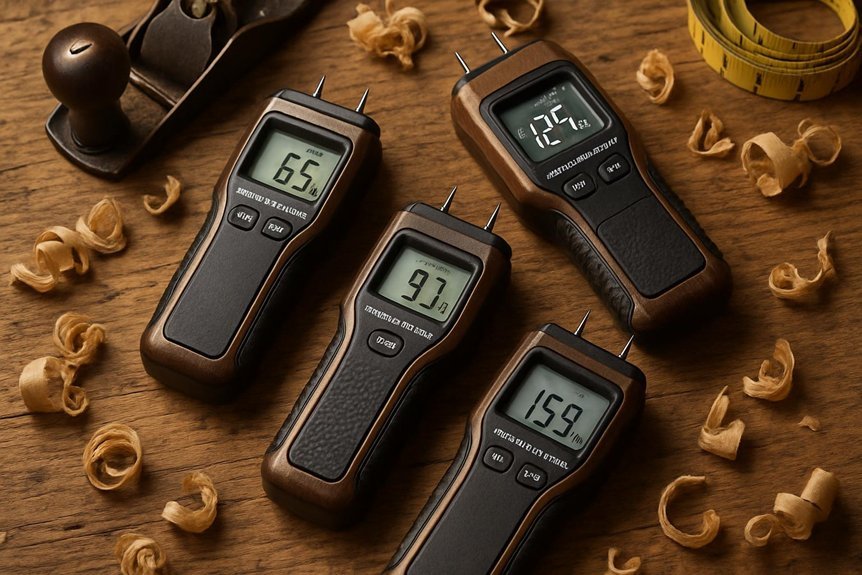
If you’re an experienced woodworker involved in crafting hardwoods, cabinetry, or fine furniture, you understand the critical importance of moisture control. The right moisture content can mean the difference between a flawless finish and a project plagued with warping or splitting.
That’s where a reliable wood moisture meter comes into play.
In this roundup, I’ve curated a selection of the four best moisture meters tailored for professionals like you. These meters are designed to deliver precise readings, whether you prefer pin, pinless, or combo styles.
When choosing the right tool, it’s essential to consider accuracy, reliability, and how well the meter fits into your workflow—factors that can significantly impact your craftsmanship.
Each of the recommended meters comes with its own set of strengths, so you’ll find options that cater to different preferences and project requirements.
Whether you’re measuring wood before assembly or checking stock in your workshop, these tools will help ensure that you achieve optimal moisture levels for your projects.
Ready to find the perfect moisture meter to elevate your woodworking? Scroll down to explore our top picks and make an informed choice for your next project!
Klein Tools ET140 Pinless Moisture Meter for Drywall, Wood, and Masonry
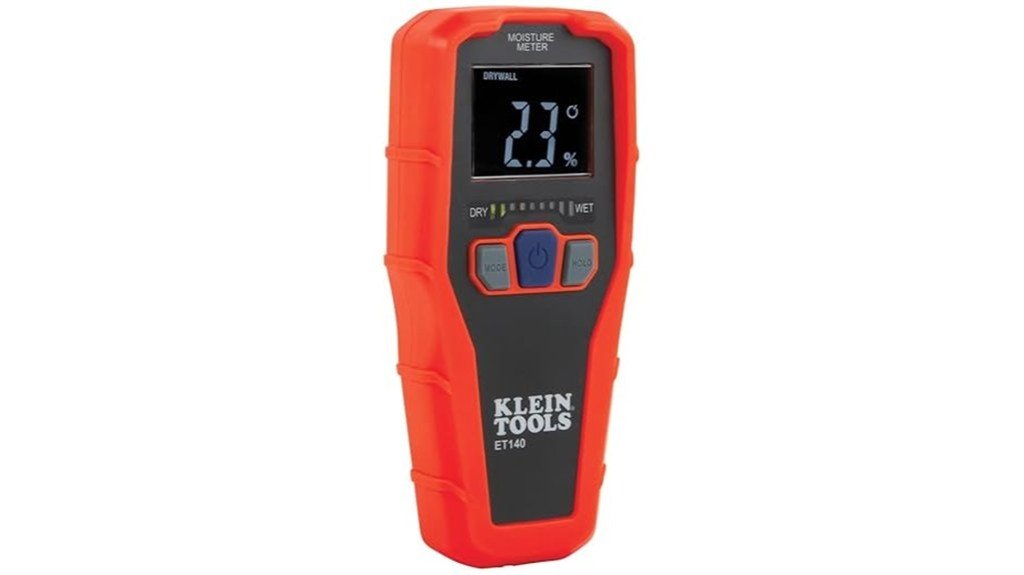
If you need a non-destructive, user-friendly meter for routine checks of drywall, masonry, and most wood species, the Klein Tools ET140 is a practical choice: it uses pinless EMF sensing to read relative moisture to about 3/4 inch deep, so you can scan finished surfaces without leaving holes, and the reverse-contrast display with nine LED bars gives fast, easy-to-read results even in dim light. You’ll appreciate its hold function, low-battery indicator, and auto-off, plus the lightweight kit with 9V battery and drop protection. It’s simple to use, good for identifying hidden leaks, and cost-effective for pros and DIYers.
Best For: homeowners and professionals who need a non-destructive, easy-to-use moisture scanner for routine checks of drywall, masonry, and most wood species.
Pros:
- Pinless EMF sensing reads up to 3/4″ (19 mm) deep so you can scan finished surfaces without leaving holes.
- Reverse-contrast display with nine LED bars and hold function provides fast, easy-to-read results even in low light.
- Lightweight, portable kit with drop protection and auto-off makes it convenient and cost-effective for pros and DIYers.
Cons:
- Readings can vary by species and surface; hardwood results may read lower and some users recommend cross-checking with another meter.
- Requires a 9V battery, which may need frequent replacement with heavy use.
- Performance can be less reliable in tight corners or when not pressed firmly against the surface.
General Tools MMD4E Digital Pin-Type Moisture Meter (Backlit LCD, Audible/Visual Alerts)
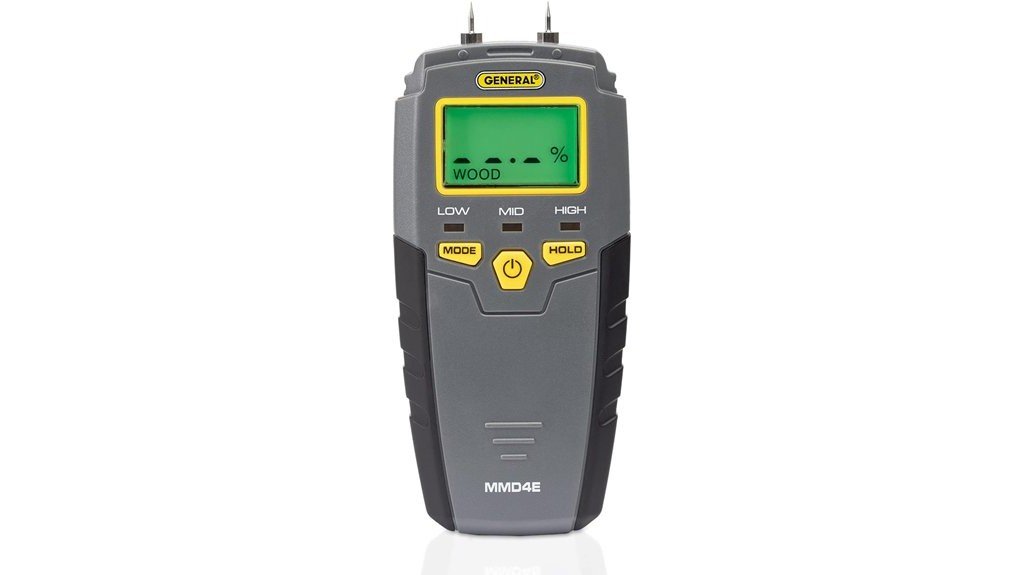
For woodworkers who need a quick, reliable check of lumber moisture before cutting or finishing, the General Tools MMD4E Digital Pin-Type Moisture Meter is a practical choice, combining a backlit LCD and large 0.3‑inch digits for easy reading in dim shops. You’ll get stainless steel pins that measure electrical resistance to report wood moisture from 5–50% and building materials from 1.5–33%. Ergonomic and lightweight, it beeps when readings complete, offers audible/visual alerts for high, medium, and low levels, and includes a HOLD button and extra pins. It runs on a 9V battery, auto powers off, and carries a one‑year warranty.
Best For: Woodworkers, contractors, and homeowners who need a quick, reliable check of lumber or building materials for moisture before cutting, finishing, or remediation.
Pros:
- Backlit LCD with large 0.3‑inch digits and audible/visual alerts for easy, fast readings in dim or noisy environments.
- Stainless steel two‑pin system provides accurate moisture ranges for wood (5–50%) and building materials (1.5–33%); includes extra pins and HOLD function.
- Lightweight, ergonomic design with auto power‑off, 9V battery included, and a 1‑year warranty.
Cons:
- Pin‑type meters leave small probe holes in finished or delicate surfaces, which may be undesirable for some applications.
- Limited measurement range and accuracy compared with some high‑end meters or non‑invasive pinless models for thicker materials.
- Operating temperature range and ±3°F accuracy may limit use in extreme environments.
PREXISO Wood Moisture Meter (7-in-1 Digital Pin-Type Dampness Meter)
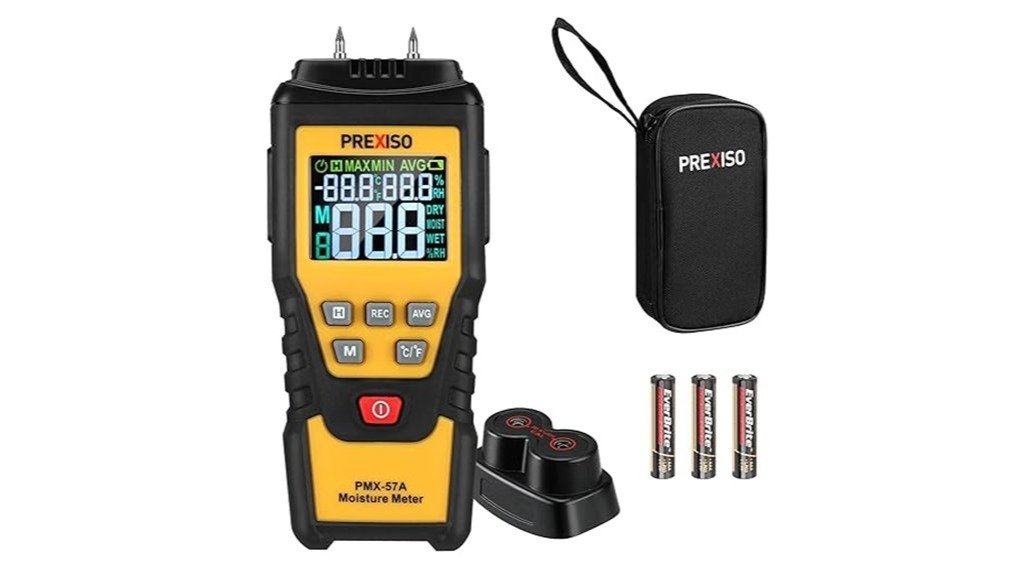
The PREXISO 7‑in‑1 wood moisture meter is a smart choice for woodworkers and flooring installers who need a single tool that handles everything from firewood to hardwood flooring, thanks to its dual stainless‑steel pins and seven calibration scales that cover softwoods, hardwoods, and building materials. You’ll get four measurement modes — single point, multi‑point average, maximum, and minimum — plus temperature and humidity readings, letting you diagnose moisture issues precisely. The backlit LCD and hold function make readings easy, and users praise its effectiveness for firewood and flooring. Note battery access and calibration info could be clearer.
Best For: Woodworkers, flooring installers, lumber suppliers, and homeowners who need a single, accurate tool to check moisture in firewood, hardwoods, and building materials before use or purchase.
Pros:
- Dual high‑precision stainless steel pins and seven calibration scales provide accurate moisture readings across softwoods, hardwoods, and building materials.
- Four measurement modes (single, multi‑point average, max, min) plus temperature and humidity readings offer versatile diagnostics.
- Backlit LCD and hold function make readings easy to read and use in the field.
Cons:
- Battery compartment requires a small screwdriver to access, which can be inconvenient.
- Instructions and on‑unit guidance for interpreting readings and calibration are limited or hard to read.
- Calibration details are on a separate leaflet rather than clearly labeled on the device.
TopTes Digital Wood Moisture Meter (TS-630)
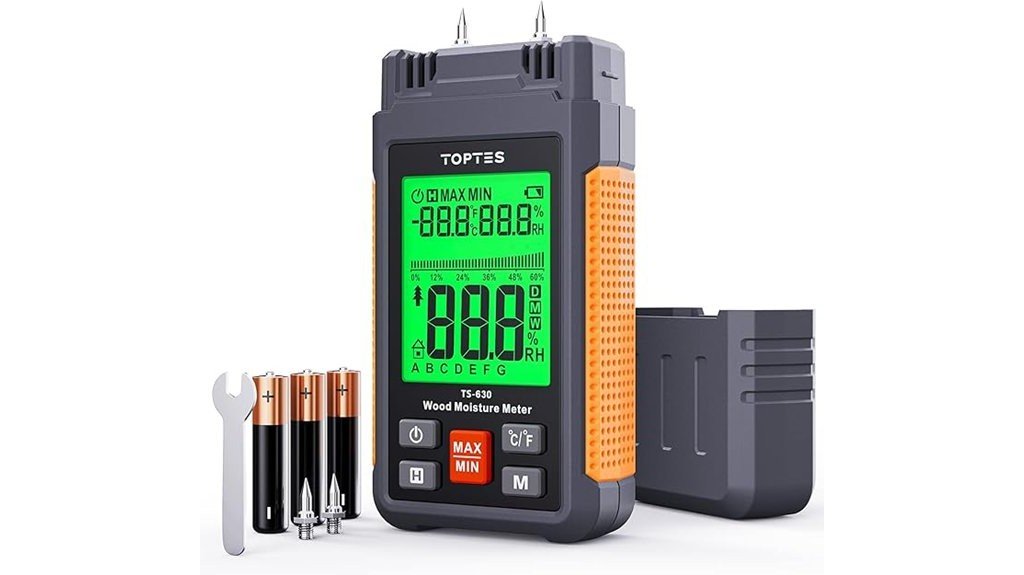
Woodworkers who need quick, reliable readings will find the TopTes TS-630 a practical choice, thanks to its large 2.25-inch tricolor LCD that instantly flags low, medium, or high moisture levels. You’ll appreciate the clear percentage readout and bar graph, plus seven calibration scales that cover wood and building materials from 0.0% to 57%. The pin-type sensor delivers precise readings without calibration, and handy features like Date Hold, Max/Min, auto shut-off, and low-battery alert improve workflow. Compact and battery-powered with a three-year warranty, it’s praised for accuracy and portability, though some users note sensitivity to drops.
Best For: Woodworkers, contractors, and homeowners who need quick, portable, and easy-to-read moisture checks for firewood, lumber, drywall, and water-damage assessments.
Pros:
- Large 2.25-inch tricolor LCD with percentage readout and bar graph for instant low/medium/high assessment.
- Seven calibration scales and a pin-type sensor provide precise readings (0.0%–57%) with useful Date Hold and Max/Min functions.
- Compact, battery-powered design (3 AAA included), auto shut-off, low-battery indicator, and 3-year warranty.
Cons:
- Pin-type meters can be sensitive to accidental drops; some users report durability concerns after impacts.
- Readings require surface penetration, which may not be suitable for finished surfaces or where pin holes are undesirable.
- Not a substitute for advanced diagnostic tools for complex moisture problems or deep moisture profiling.
Factors to Consider When Choosing Wood Moisture Meters for Experinced Woodworkers
When you’re choosing a moisture meter as an experienced woodworker, you’ll want to prioritize measurement accuracy and range so you can trust readings across different species and thicknesses. Decide between pin and pinless models based on whether you need surface precision or non‑destructive testing, and check for material calibration scales and fast, stable response times to match your workflow. Finally, don’t overlook build quality and durability—robust construction and good ergonomics keep the tool reliable in a busy shop.
Measurement Accuracy and Range
Accuracy and range matter a lot when you’re choosing a moisture meter, because even a few percentage points can be the difference between a stable board and one that will cup, crack, or fail in glue joints. You should expect typical wood readings from about 5% to 50%, and many meters include separate calibration scales for softwood and hardwood to improve precision across species. Look for models that quote accuracy, commonly around ±3%, since tighter tolerance helps prevent costly mistakes. Consider the measurement range too: some tools detect moisture in building materials like drywall and concrete, often from roughly 1.5% to 33%, expanding their usefulness. Finally, assess whether the meter’s design and technology deliver consistent, repeatable readings under your shop conditions.
Pin Vs Pinless
Choosing between pin and pinless moisture meters comes down to the trade-offs you’re willing to accept for precision, convenience, and the condition of the wood you’re testing. Pin meters use stainless steel pins to measure electrical resistance and give accurate moisture-content readings—typically from about 5% to 50%—making them ideal when you need precise, species-specific data for project lumber. Pinless meters use electromagnetic fields to scan without puncturing, useful for quick checks across finished surfaces and for materials like drywall or concrete to roughly 3/4-inch depth. Pins can leave small holes in delicate or finished pieces, while pinless units avoid damage but may be less exact on certain woods. As a pro, choose pin for detailed assessment and pinless for non-destructive, fast surveys.
Material Calibration Scales
Because different species and building materials conduct moisture differently, you’ll want a meter with multiple calibration scales so readings reflect the specific wood or substrate you’re testing. Choose a meter offering several scales — some use up to seven — so you can match softwoods, hardwoods, and common construction materials for more reliable results. Look for ranges that cover roughly 0% to 57% moisture to handle both dry stock and wetter conditions. Remember that using the correct scale directly affects accuracy, helping you avoid warping, splitting, or failed joins. Many meters also include modes for drywall and masonry, which is handy when evaluating subfloors or framed walls before installation. Calibrate and verify against a known sample regularly.
Response Time and Stability
Quick response time can make a big difference when you’re working through a pile of boards or troubleshooting a damp subfloor, so you’ll want a meter that delivers fast, reliable readings without forcing you to wait or second-guess the result. Look for meters that give readings in seconds so you can move quickly from piece to piece; long lag times slow workflow and invite mistakes. Stability matters just as much — consistent results over repeated tests build confidence, while erratic swings suggest sensor or calibration issues. Pin meters often return steadier values because they use electrical resistance, whereas pinless units can vary with surface conditions. Features like reading-hold and averaging reduce transient noise, and solid calibration stability means less frequent recalibration and more trusted data.
Build Quality and Durability
A meter’s speed and reading stability mean little if the unit itself can’t survive a busy shop, so after you’ve evaluated response time you’ll want to scrutinize build quality and durability. Look for units made from sturdy plastics or metal that resist everyday knocks and occasional drops; a solid housing reduces repair costs and downtime. Protective casings, rubberized bumpers, or reinforced seams add shock resistance and extend service life. Prefer stainless steel pins for probes because they resist corrosion and hold calibration longer, maintaining accuracy as you use them. A lightweight design improves portability without sacrificing ruggedness, making prolonged use less fatiguing. Finally, read user reviews for patterns of wear and tear—real-world feedback often reveals durability strengths and weaknesses.
Data Logging and Hold
When you need to monitor moisture trends across a shop or a long build, data logging and hold features turn a moisture meter from a simple tool into a project-management asset. You’ll appreciate data logging when tracking multiple readings over days or weeks; it lets you spot drying trends, compare boards or batches, and plan assembly or finishing with confidence. Use the hold function to freeze a reading when conditions or access make immediate recording awkward, avoiding guesswork or repeated probing. Look for meters with max/min recording to capture extremes during a session, which gives a clearer picture of material variability. For larger jobs, consider models that export logs to software so you can analyze, archive, and report moisture data efficiently.
Display Readability and Backlight
Because you’ll often work in dim corners, under benchtop lights, or out on a shaded job site, readable displays and reliable backlighting are essential features that let you trust every moisture reading. Choose meters with large, high-contrast digits so you can read values quickly without squinting, which reduces misreads and speeds workflow. Backlit screens keep readings visible when ambient light is poor, so you won’t need to fetch a flashlight mid-measurement. Color-coded displays give immediate context — safe, caution, and danger zones — letting you act faster on wet or dry stock. Graphical elements like bar graphs supplement numbers with an intuitive visual trend, helpful for spot checks. Finally, pick a size and orientation that stays readable from different angles and working positions for maximum usability.
Power Source and Battery Life
Even if you’re working long hours on a job site, the meter’s power design will determine how reliably you can log moisture readings without interruption, so it’s worth weighing battery type, life, and power-management features before you buy. Many meters use 9V or AAA batteries, and that choice affects how often you’ll swap cells; AAA packs are lighter and often easier to source, while 9V can last longer in some designs. Look for models with auto power-off and clear battery indicators to avoid surprise shutdowns during critical checks. Also consider whether replacing batteries needs tools or extra steps, since quick swaps keep you productive. Prioritize efficient power management to maximize run time and reduce downtime on long projects.
FAQ
Can Moisture Meters Detect Chemical Treatments or Finishes?
FAQs on Moisture Meters and Chemical Treatments
1. Can moisture meters detect chemical treatments?
No, moisture meters do not detect chemical treatments or finishes; they only measure the moisture content in materials.
2. How do moisture meters work?
Moisture meters function by measuring electrical resistance or dielectric properties, which are related to water content in the material.
3. Will moisture meters give accurate readings on treated surfaces?
Moisture meters often provide skewed readings on varnished, painted, or chemically treated surfaces due to the presence of finishes.
4. What should I do for accurate moisture readings on treated surfaces?
For accurate readings, consider stripping a small area of the finish or using penetrating probes designed for such measurements.
5. How can I identify chemical treatments on materials?
To identify chemical treatments, rely on lab analysis, solvent tests, or manufacturer records instead of moisture meters.
6. What is the primary limitation of moisture meters?
The primary limitation of moisture meters is their inability to assess chemical composition; they focus solely on moisture levels.
7. Are there alternative methods to analyze chemical treatments?
Yes, alternative methods include laboratory testing and solvent-based analyses, which can provide insights into chemical treatments.
8. Can moisture meters be used in all materials?
While moisture meters can be used on many materials, their effectiveness may vary based on the material’s surface treatment.
9. Do moisture meters work on wood surfaces?
Yes, moisture meters are commonly used on wood surfaces, but readings can be affected by finishes applied to the wood.
10. Is moisture content the only factor to consider in material analysis?
Moisture content is important, but it’s crucial to also consider chemical treatments or finishes for a comprehensive material analysis.
How Often Should I Calibrate a Moisture Meter?
1. How often should I calibrate my moisture meter?
You should calibrate your moisture meter at least once a month if used regularly. Additionally, calibrate it before any critical jobs to ensure accurate readings.
2. What factors necessitate recalibrating my moisture meter?
Recalibration is necessary after drops, exposure to extreme conditions, or prolonged storage. These factors can affect the meter’s accuracy.
3. What is the best time to check my moisture meter’s calibration?
Always check the calibration before undertaking important tasks. This helps prevent inaccuracies that could lead to costly mistakes.
4. What should I use for calibration?
Follow the manufacturer’s calibration procedure and use known reference materials or a calibration block. This ensures reliable calibration outcomes.
5. How can I document calibration adjustments?
Keep a log of any calibration adjustments made to your moisture meter. Documenting changes helps maintain a history of its accuracy and performance.
6. What happens if I don’t calibrate my moisture meter regularly?
Failing to calibrate can lead to drift in readings, resulting in unreliable data. This can cause significant issues, especially in moisture control situations.
7. What is the consequence of inaccurate moisture readings?
Inaccurate readings can lead to poor decision-making in moisture control. This may result in damage to materials or increased costs in remediation.
8. Is there a specific procedure for calibration?
Yes, the calibration procedure varies by manufacturer, so consult the user manual for specific instructions. Following these guidelines ensures proper calibration.
9. Can environmental conditions affect moisture meter accuracy?
Yes, extreme temperatures and humidity levels can impact the accuracy of moisture meters. Regular calibration helps to mitigate these effects.
10. How do I know when my moisture meter needs recalibration?
Aside from a regular schedule, recalibrate your meter whenever you suspect it may be giving inaccurate readings. Observing inconsistent results can be a sign that it needs adjustment.
Are Pinless Meters Safe for Delicate Veneers?
1. Are pinless meters safe for delicate veneers?
Yes, pinless meters are safe for delicate veneers as they measure moisture without puncturing the surface, preventing damage like pinholes or splintering.
2. Do pinless meters require good contact with the veneer?
Yes, ensuring good contact between the meter and the veneer is essential for accurate readings.
3. Can pinless meters be used on very thin veneers?
It’s advisable to avoid using pinless meters on very thin or highly laminated veneers, as readings may average out the moisture content of underlying layers.
4. How can I ensure the accuracy of a pinless meter?
Verify the calibration of your pinless meter against a known reference to ensure accurate moisture readings.
5. Is it necessary to test in an inconspicuous area first?
For critical work, it is recommended to test an inconspicuous area first to prevent any potential damage.
6. Should I combine pinless readings with other methods?
Yes, combining pinless readings with visual inspections can provide the best results for assessing the condition of the veneer.
7. What is the main advantage of using a pinless meter?
The main advantage is that pinless meters can measure moisture without causing any physical damage to the surface of the veneer.
8. Can moisture readings vary between different types of veneers?
Yes, moisture readings can vary significantly between different types of veneers, especially if they are thin or laminated.
9. Are there specific veneers I should avoid using pinless meters on?
Yes, avoid using pinless meters on very thin or highly laminated veneers to prevent inaccurate readings.
10. How do I maintain the accuracy of my pinless meter?
Regularly check the calibration of your pinless meter and perform maintenance as recommended by the manufacturer to maintain accuracy.
Can Moisture Meters Measure Moisture in Stacked Lumber?
FAQ 1: Can I use a moisture meter on stacked lumber?
Yes, you can measure moisture in stacked lumber, but the readings may be limited.
FAQ 2: What type of moisture meter is best for stacked lumber?
Pinless meters are suitable as they can read through several thin boards, provided there is solid contact.
FAQ 3: What are the limitations of pin meters?
Pin meters only measure the moisture at the surface between the pins, which may not reflect the moisture content deeper in the wood.
FAQ 4: How can I obtain accurate moisture readings in stacked lumber?
To achieve deep and accurate profiling, take multiple readings at various levels within the stack.
FAQ 5: Should I measure the edges and faces of the lumber?
Yes, it is advisable to measure both the edge and face of the lumber to get a comprehensive understanding of moisture levels.
FAQ 6: Is it important to allow for air gaps when measuring?
Absolutely, allowing air gaps is essential for penetration and obtaining accurate readings.
FAQ 7: Do I need to calibrate my moisture meter?
Yes, calibrating your meter for the specific wood species and thickness is crucial for precise measurements.
FAQ 8: Can I rely on a single reading for moisture content?
No, relying on a single reading may lead to misleading averages; it’s better to combine methods for a thorough assessment.
FAQ 9: How do I take multiple readings effectively?
Take readings at different levels and areas within the stack to capture a range of moisture content.
FAQ 10: Are there specific conditions that affect moisture readings in lumber?
Yes, factors such as temperature, humidity, and wood species can influence moisture readings, so always consider these variables when measuring.
Do Temperature or Humidity Affect Meter Accuracy?
1. Do temperature extremes affect meter readings?
Yes, temperature extremes can lead to slight shifts in meter readings due to changes in electrical resistance and pin contact.
2. How does humidity impact meter accuracy?
Relative humidity can alter the surface moisture that contact or pinless meters detect, which may affect the accuracy of readings.
3. Should I acclimate my meter and wood?
Yes, it is recommended to let both the wood and the meter acclimate to the same environment to ensure accurate readings.
4. What are temperature-compensated meters?
Temperature-compensated meters are designed to adjust their readings based on the temperature, improving accuracy in varying conditions.
5. Are there ways to correct meter readings?
Yes, you can correct readings using manufacturer charts or formulas, which can help achieve more precise results.
6. Why does moisture tolerance matter in readings?
When tight moisture tolerances are required, accurate readings are crucial to avoid issues in applications like construction or woodworking.
7. What types of meters are affected by humidity?
Both contact and pinless meters can be impacted by changes in humidity, affecting their measurement accuracy.
8. Is it important to check the environment before taking readings?
Absolutely, the environment’s temperature and humidity levels should be considered prior to taking readings for the best accuracy.
9. Can I use a meter in extreme weather conditions?
Using a meter in extreme weather conditions can lead to inaccurate readings, so it’s best to avoid such situations if possible.
10. What happens if I don’t acclimate the meter and wood?
Failing to acclimate both can result in misleading moisture content readings, leading to potential issues in your project.
Final Thoughts
You’ll get consistent, professional results by choosing one of these meters—each balances speed, accuracy, and durability for workshop or jobsite use. Pick the Klein ET140 for non‑destructive scans, the General MMD4E for quick pin readings with alerts, the PREXISO for multi‑scale versatility, or the TopTes TS‑630 for a large, responsive display. Match the meter to your material types and workflow, and you’ll reduce surprises, improve drying decisions, and protect project quality.