
If you’re a woodworking enthusiast looking to elevate your craft at home, a quality scroll saw is essential for achieving clean and precise cuts. This guide is tailored for DIYers of all skill levels and budgets, presenting five top-notch scroll saws that cater to your specific needs.
Whether you’re a beginner tackling simple projects or an experienced woodworker seeking advanced features, we’ve got you covered.
Choosing the right scroll saw can be overwhelming, especially with so many options available. That’s why we’ve narrowed down our selections based on crucial criteria such as variable speed settings, throat capacity, ease of blade changes, and additional features like LED lights and dust collection systems.
These elements can significantly enhance your woodworking experience, making tasks easier and more efficient.
No matter your project requirements or workspace limitations, our curated list will help you find the perfect scroll saw that meets your expectations.
Dive into our picks to discover which model aligns best with your woodworking ambitions. Keep scrolling to explore our top recommendations!
Shop Fox W1872 16-Inch Variable Speed Scroll Saw with Foot Switch, LED, and Miter Gauge
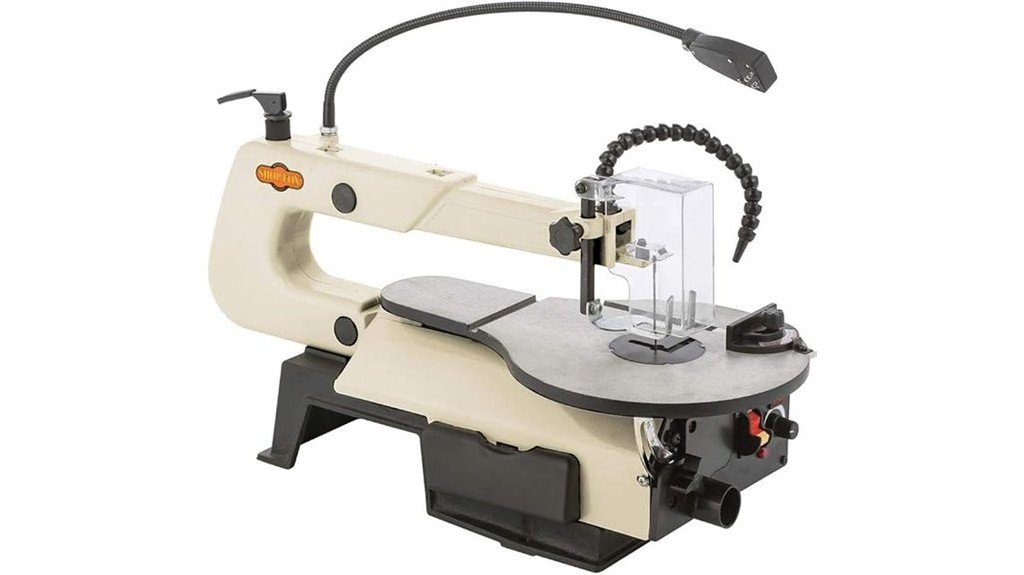
If you’re a hobbyist woodworker who values versatility and control, the Shop Fox W1872 stands out for its foot‑pedal variable speed and 16‑inch throat capacity, which together let you tackle larger patterns while dialing in precise blade speed from 550 to 1600 SPM; you’ll appreciate the LED work light and dust blower that improve visibility and cleanliness during detailed cuts, though the saw’s light weight means you’ll need to secure it well to avoid vibration at higher speeds. You get a 1/6 HP motor, 2-1/4″ cutting depth, tilt table, miter gauge and pinless adapter, plus a two‑year warranty.
Best For: hobbyist woodworkers who need a versatile, 16‑inch throat scroll saw with foot‑pedal variable speed for detailed and larger pattern work.
Pros:
- Foot‑pedal variable speed control provides precise, responsive speed adjustment for delicate cuts.
- 16‑inch throat and 2‑1/4″ cutting depth accommodate larger patterns and thicker stock.
- Included LED work light, dust blower, miter gauge, and pinless adapter add useful functionality out of the box.
Cons:
- Lightweight construction can cause vibration and movement at higher speeds unless securely anchored.
- Bottom blade holder access and blade changes can be awkward and cumbersome.
- Table lacks a true 90° stop and some included accessories (like rotary attachment) may be unnecessary for many users.
16-Inch Variable Speed Scroll Saw for Precision Woodworking
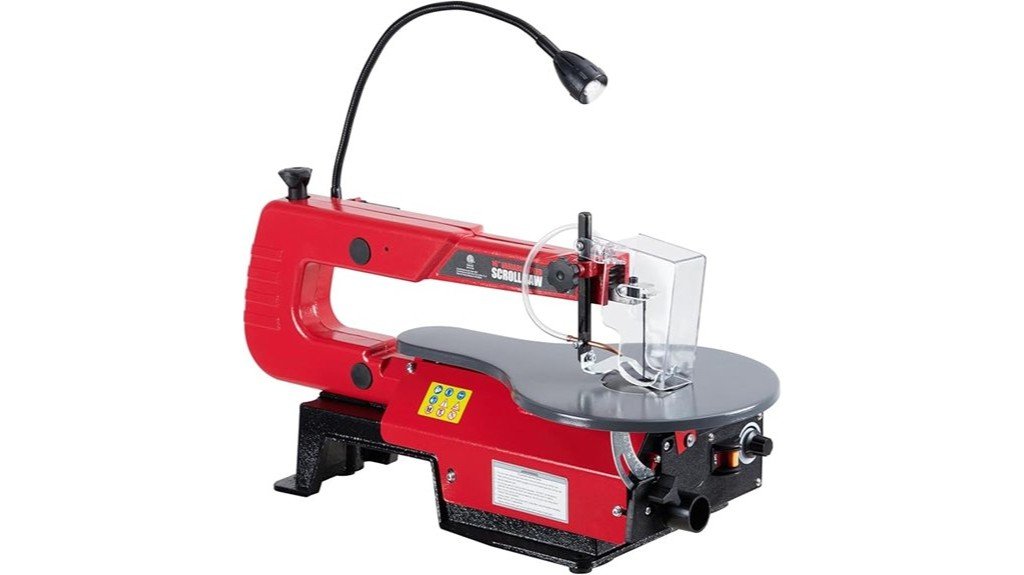
Woodworkers seeking precise control over fine, intricate cuts will find the 16-inch variable speed scroll saw a standout choice, especially when tackling detailed fretwork or inlay projects. You’ll appreciate its extra-large worktable that tilts from 0° to 45° for angled cuts, the built-in LED light for improved visibility, and an integrated dust port that keeps your workspace cleaner. With speeds from 400 to 1600 SPM, stainless steel blades, and a sturdy cast iron base, it handles various woods for hobby or professional use. It’s corded electric, weighs 26.6 pounds, and comes with a limited warranty.
Best For: Woodworkers—hobbyists and small-shop professionals—who need precise, intricate cuts and adjustable angled cutting capability for fretwork, inlays, and detailed patterns.
Pros:
- Extra-large tilting worktable (0°–45°) for accurate angled cuts and better material support.
- Variable speed (400–1600 SPM), built-in LED light, and stainless steel blades for versatile, precise cutting.
- Sturdy cast iron base with integrated dust port and blower helps stability and a cleaner workspace.
Cons:
- Some users reported speed control issues that can affect consistent cutting performance.
- Reports of stripped screws on replacement units indicate potential quality-control or assembly problems.
- Corded electric design limits portability compared with cordless alternatives.
WEN 3922 16-inch Variable Speed Scroll Saw with Easy-Access Blade Changes
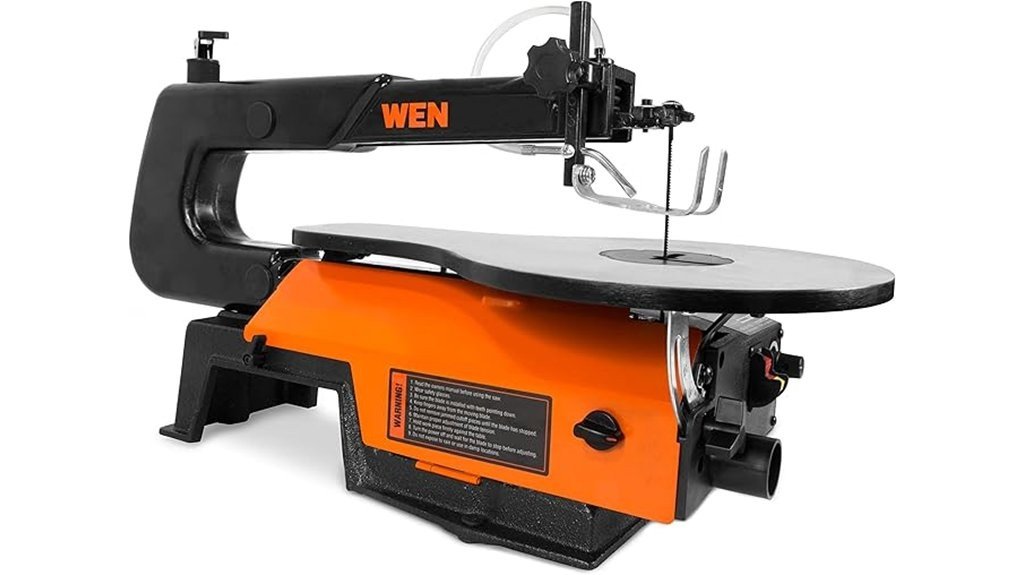
For hobbyists and serious weekend makers who need a reliable, easy-to-use saw for detailed cutting, the WEN 3922 stands out for its quick-access side panel that makes blade changes fast and frustration-free. You’ll appreciate the 16-inch throat depth and variable speed range (550–1600 SPM) when maneuvering intricate patterns in hardwoods or softer materials, and the 16-by-10-inch table bevels to 45° for angled work. The cast-iron base, thumb-screw blade adapter, air pump, and dust port enhance accuracy and visibility, though the metal base plate edge can catch small pieces and only three blades are included. Overall, it’s a strong value choice.
Best For: hobbyists and weekend woodworkers who need an affordable, easy-to-use scroll saw for detailed cuts and angled work.
Pros:
- Quick-access side panel for fast, frustration-free blade changes.
- Variable speed (550–1600 SPM) and 16″ throat depth enable intricate work in hardwoods and soft materials.
- Cast-iron base, thumb-screw blade adapter, air pump, and dust port improve accuracy and visibility.
Cons:
- Metal base plate edge can catch small workpieces.
- Only three 5-inch blades included, so extra blades may be needed.
- Some users report vibration unless additionally mounted or stabilized.
SKIL 16 in. Variable Speed Scroll Saw (SS9503-00)
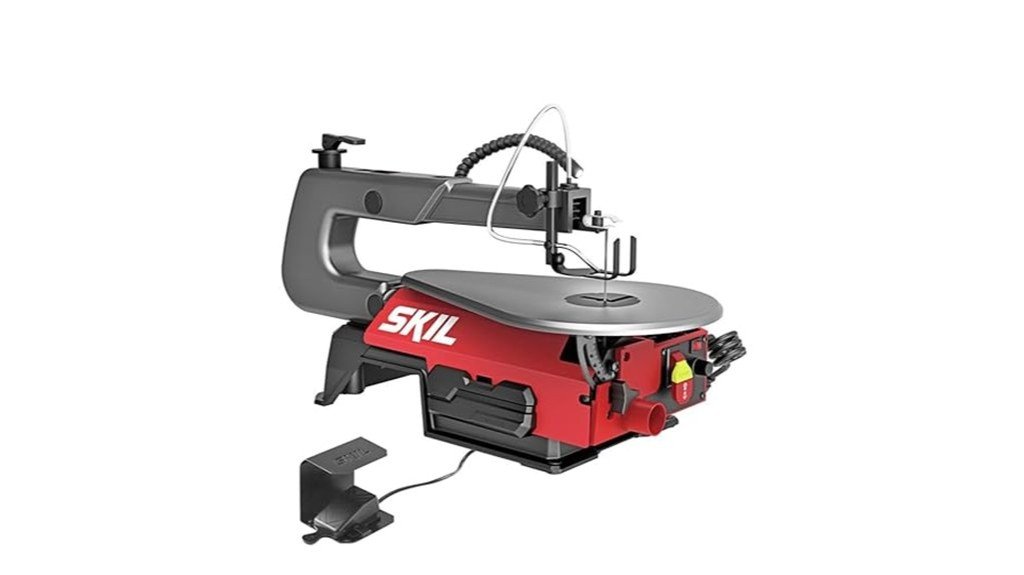
The SKIL 16 in. Variable Speed Scroll Saw (SS9503-00) gives you a versatile, user-friendly platform for precise home woodworking. Its 16″ x 10″ tilting table (0–45°) lets you angle cuts accurately, while electronic variable speed adapts to delicate or dense materials. You’ll appreciate the integrated LED light and dust removal system that keep the cut line visible and clean. Hands-free control via the foot pedal and convenient on-tool blade storage speed workflow, and keyless blade changes minimize downtime. With 1.2-amp power and thoughtful features focused on accuracy, this model balances convenience and control for DIYers.
Best For: DIY woodworkers and hobbyists who need a compact, versatile scroll saw for precise angled and intricate cuts in a home workshop.
Pros:
- Electronic variable speed and 16″ x 10″ tilting table (0–45°) allow precise control for a range of materials and angled cuts.
- Integrated LED work light and dust removal system improve cut visibility and cleanliness.
- Hands-free foot pedal, on-tool blade storage, and keyless blade changes speed workflow and reduce downtime.
Cons:
- 1.2-amp motor may be underpowered for very thick or heavy-duty professional cutting tasks.
- Table size and capacity are best suited for small to medium projects, limiting large workpiece handling.
- No mention of advanced vibration-reduction features, which may affect ultra-fine precision for some users.
Bucktool 16 Inch Variable Speed Scroll Saw for Woodworking
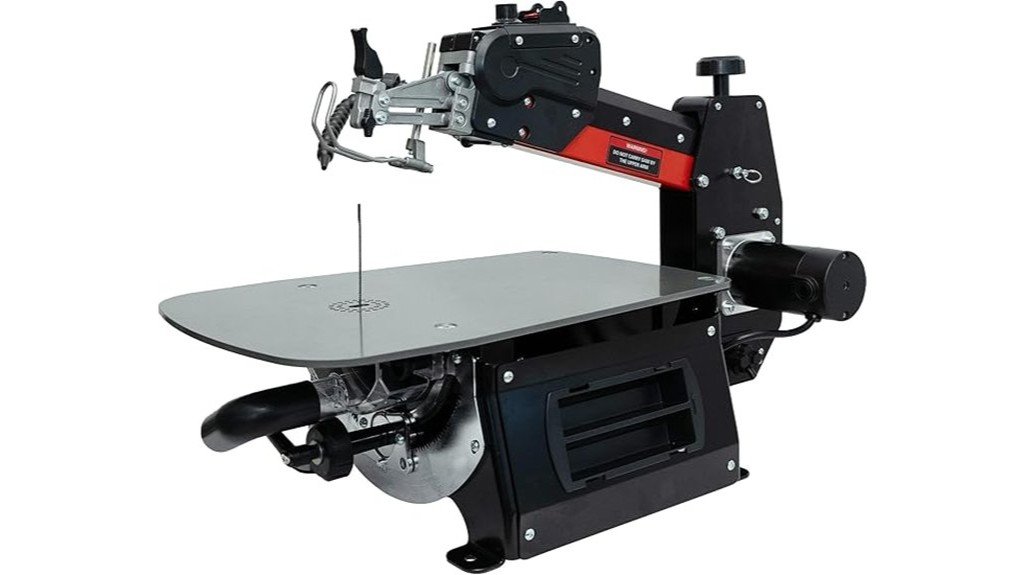
If you’re a hobbyist aiming to step up from basic jigsaws to a dedicated benchtop machine, the Bucktool 16 Inch Variable Speed Scroll Saw makes a compelling choice thanks to its mix of precision features and user-friendly design. You’ll get a 1.3A motor with a double parallel-link drive, variable speed from 360–1550 RPM, and a rotating arm that tilts 30° left and 45° right for bevels. The large 19-11/16 by 13-3/8 table, quick blade changes, dust management, and integrated tool storage support focused woodworking. Weighing 57.3 pounds, it’s stable, backed by a two-year warranty and strong user ratings.
Best For: Hobbyist woodworkers and beginners stepping up from a jigsaw who want a stable, feature-rich benchtop scroll saw for detailed cutting and bevel work.
Pros:
- Variable speed (360–1550 RPM) and double parallel-link drive allow precise control for delicate cuts.
- Large 19-11/16 x 13-3/8 worktable, rotating arm (30° left, 45° right), and quick blade changes improve versatility and workflow.
- Good value with dust management features, integrated tool storage, and a 2-year manufacturer’s warranty.
Cons:
- 1.3A motor may be underpowered for very thick hardwoods or heavy-duty production work.
- Some users report vibration issues if the saw is not properly secured or bolted down.
- Included blades (15 TPI and 18 TPI pinless) may prompt users to try other brands for optimal performance.
Factors to Consider When Choosing Scroll Saws for Home Woodworking
When you’re choosing a scroll saw for home woodworking, focus first on motor power and torque since they determine how well the saw handles thicker or denser materials. Check blade type and access, speed range control, and table size and tilt to guarantee the machine matches the cuts you plan to make and the comfort of your work setup. Also prioritize low vibration and a stable base so your cuts stay precise and your projects come out cleaner.
Motor Power and Torque
Think of motor power and torque as the heart and muscle of a scroll saw—you’ll want a motor that matches the size and density of the wood you plan to cut, since most hobbyist saws offer anywhere from about 1/6 HP up to roughly 1.3 A equivalents with variable speed settings. You’ll look for sufficient torque when cutting thicker hardwoods, because higher torque maintains smooth motion under load and reduces stalling or bogging down. Variable speed, typically 400–1600 SPM, pairs with power to let you dial in clean cuts for delicate veneers or faster work on softer stock. A robust motor also runs cooler and lasts longer during extended projects, so choose a model whose power and torque suit your regular materials and project scale.
Blade Type and Access
One of the first decisions you’ll make with a scroll saw is the blade type and how easily you can access and change it, because these factors directly affect the kinds of cuts you can make and how smoothly your workflow will run. Choose pinless blades when you want very intricate curves and quick swaps; they free you from threading and speed up pattern work. Pinned blades add stability for thicker stock, so pick them for tougher projects. Check how the blade holder is accessed—side panels or tool-less clamps save time—and prefer models with simple tension adjustments so you keep blades straight and cuts true. Remember blade stroke length influences depth, and maintain the holder and surrounding parts regularly to avoid frustration and guarantee consistent performance.
Speed Range Control
Good speed control can make a dramatic difference in how your scroll saw performs, so you’ll want to evaluate both the range and the smoothness of adjustment before you buy. Most scroll saws offer variable speeds roughly from 400 to 1600 strokes per minute (SPM), and that span matters: slower settings give you the finesse needed for intricate patterns, while higher SPMs push through thicker or denser woods more quickly. Choose a model with a broad, steady range so you can work across softwoods and hardwoods without sacrificing control. Smooth adjustment prevents blade binding and yields cleaner cuts. Also consider hands-free options like foot pedals, which let you fine-tune speed while keeping both hands free to guide delicate work.
Table Size and Tilt
After you’ve settled on the right speed range, give close attention to the table — its size and tilt will shape what projects you can handle and how accurately you can cut. The table’s dimensions dictate the maximum material width you can manage; larger tables increase versatility for bigger panels or longer patterns, while typical 16-inch tables strike a practical balance between portability and capacity. A tilting worktable, usually adjustable from 0° to 45°, lets you execute precise angled and bevel cuts needed for decorative edges or joints, improving the finished look. Verify the table is stable and adequately sized so the material won’t shift during cutting, which preserves accuracy and safety. Choose a saw whose table matches your typical project scale and cutting needs.
Vibration and Stability
Because vibration can quickly undo careful layout and steady hands, you’ll want to prioritize stability when choosing a scroll saw. Lightweight models are portable, but they can buzz and hop during cuts, reducing accuracy and forcing you to add stabilizers like rubber bumpers or friction pads. By contrast, saws with heavier cast iron bases absorb motor movement and deliver steadier, smoother cuts, so you’ll get cleaner detail work with less effort. Excessive vibration also makes clamping the saw to a bench harder and undermines control, especially at higher speeds where users often notice more shake. Secure mounting to a solid surface and managing speed settings will mitigate most issues, letting you maintain precision without sacrificing the maneuverability you need for intricate woodworking.
Dust Collection Effectiveness
Vibration control and a steady table make accurate cuts possible, but keeping the work area clear of sawdust is just as important for precision and safety. You’ll want a scroll saw with effective dust collection to maintain visibility of cut lines and reduce airborne particles that can harm your lungs. Look for integrated dust ports so you can hook up a shop vacuum, and note whether the port size matches common hoses for maximum suction. Built-in dust blowers are helpful for immediately clearing debris from the blade path, while adjustable dust hoods let you target stubborn dust zones. Because poor dust control raises respiratory and safety risks, prioritize models with well-designed collection features to keep your workspace cleaner and your cuts more accurate.
Additional Accessories Included
A few well-chosen accessories can make a big difference in how smoothly you work and how good your finished pieces look, so give extra weight to which extras come with a scroll saw. You’ll want a foot switch for hands-free control during delicate maneuvers, which keeps both hands steady on the workpiece. LED work lights improve visibility and accuracy, especially in dim shops, while a built-in dust blower or dust port keeps cut lines clear by removing debris as you go. Look for convenience items too — a miter gauge helps with angled cuts, integrated blade storage prevents lost blades, and quick blade-change systems like tool-less clamps or thumb-screw adapters cut downtime considerably. Prioritize features that match your workflow.
FAQ
Can Scroll Saws Cut Metal or Plastics Safely?
1. Can a scroll saw cut metal?
Yes, a scroll saw can cut thin metals like brass, copper, and aluminum with the appropriate blade.
2. What type of blade should I use for cutting metal?
For cutting metal, use fine-pitch or metal-cutting blades specifically designed for that purpose.
3. What speed settings are recommended for cutting metal?
It’s advisable to use slower speeds when cutting metal to minimize heat build-up, which can damage both the material and the blade.
4. Can I cut plastics with a scroll saw?
Yes, many types of plastics can be safely cut with a scroll saw when using the right blade and settings.
5. What blade type is best for cutting plastics?
Choose blades designed to reduce chipping for cutting plastics, ensuring a smooth finish.
6. What speed should I use for cutting plastics?
Moderate speeds are recommended when cutting plastics to achieve optimal results without causing damage.
7. Do I need to secure the workpiece when cutting?
Yes, it’s essential to secure the workpiece firmly to prevent movement during cutting, ensuring precision and safety.
8. Is safety equipment necessary when using a scroll saw?
Yes, it’s important to wear eye protection and respiratory gear to safeguard against debris and dust generated during cutting.
9. Should I practice before cutting my final material?
It’s advisable to start with scrap material to fine-tune your settings and technique before working on your actual project.
10. Are there any limitations to what types of metal I can cut?
Scroll saws are best suited for thin metals; thicker or harder metals may require different tools for effective cutting.
How Loud Are Scroll Saws During Operation?
FAQs on Scroll Saw Noise Levels
1. How loud are scroll saws during operation?
Scroll saws typically operate at noise levels between 60–85 dB, which is relatively quiet compared to other power tools.
2. What factors affect the noise level of a scroll saw?
The noise level can vary based on the model, blade type, speed settings, and the material being cut.
3. Do lower speeds on a scroll saw reduce noise?
Yes, operating at lower speeds along with using fine blades can significantly decrease noise levels while cutting.
4. Does the material being cut impact noise levels?
Absolutely. Cutting denser materials, such as thick metal, can increase the noise produced by the saw.
5. Is hearing protection necessary when using a scroll saw?
While scroll saws are quieter than many power tools, using hearing protection is recommended, especially during extended use.
6. Can the surface on which the scroll saw is placed affect noise?
Yes, placing the saw on a vibration-damping surface can help reduce the perceived noise during operation.
7. Are older scroll saw models louder than newer ones?
Generally, portable or older scroll saw models tend to be louder than modern, well-maintained units.
8. What types of blades can help minimize noise?
Fine blades are known to produce less noise compared to coarser blades when cutting through materials.
9. Does speed setting influence the overall noise level?
Yes, higher speed settings can contribute to increased noise levels, so adjusting them can help manage sound output.
10. Can maintenance of a scroll saw impact its noise level?
Regular maintenance of a scroll saw can ensure optimal performance and potentially reduce noise levels during operation.
11. Is there a significant difference in noise level among different brands?
Yes, different brands and models can produce varying noise levels, influenced by their design and engineering.
Do Scroll Saws Require Frequent Blade Replacements?
1. How often should I replace my scroll saw blades?
Typically, hobbyists replace scroll saw blades after several projects or when the blade becomes dull, rough, or breaks.
2. What factors affect the lifespan of a scroll saw blade?
Blade life is influenced by the material being cut, the feed rate, and the quality of the blade itself.
3. Do harder materials wear blades out faster?
Yes, cutting hardwoods or metals tends to wear blades out more quickly compared to softer materials.
4. What can I do to extend the life of my scroll saw blades?
To prolong blade life, keep them clean, avoid forcing cuts, and use the appropriate tooth pattern for your project.
5. Is it necessary to have spare blades on hand?
Yes, having a few spare blades available is advisable for uninterrupted work when a blade breaks or dulls.
6. How can I tell when a blade needs to be replaced?
Replace the blade when you notice cuts becoming rough or when the blade breaks during use.
7. Can I use the same blade for different materials?
While some blades can cut various materials, it’s best to use blades that are specifically designed for the material you are working with for optimal results.
8. Does the feed rate impact blade wear?
Yes, a faster feed rate can lead to increased wear on the blade, so it’s important to adjust your speed according to the material and type of cut.
9. Are there specific tooth patterns for different cuts?
Yes, selecting the correct tooth pattern is crucial for achieving clean cuts and can significantly affect the blade’s longevity.
10. What maintenance should I perform on my scroll saw blades?
Regularly clean the blades to prevent resin buildup and inspect them for damage to maintain performance and extend their lifespan.
Can Beginners Learn Scroll Sawing Without Classes?
1. Can I learn scroll sawing on my own?
Yes, it is possible to learn scroll sawing without formal classes by using various resources available online and in books.
2. What should I start with when learning scroll sawing?
Begin with safety basics, familiarize yourself with a simple scroll saw, and practice making straight cuts and curves before moving on to more complex techniques.
3. How can I improve my skills in scroll sawing?
Practice regularly, work on blade changes, and gradually introduce pattern work and fretwork into your projects to enhance your skills.
4. Are there resources available for self-learning?
Yes, there are numerous online tutorials, instructional books, and practice kits that can help you learn scroll sawing independently.
5. Is it beneficial to join a community for scroll sawing?
Joining forums or local clubs can provide valuable feedback, support, and tips from more experienced scroll sawyers.
6. What should I focus on while practicing?
Concentrate on developing steady hand control, maintaining the correct speed, and selecting the proper blade for your projects.
7. Will I face challenges as a beginner?
Absolutely, expect a learning curve and be prepared to encounter mistakes as you refine your techniques in scroll sawing.
8. How important is safety in scroll sawing?
Safety is paramount; understanding and adhering to safety guidelines will help prevent accidents while using the scroll saw.
9. Can online tutorials really help me learn?
Yes, many online tutorials provide step-by-step instructions that can be very helpful for beginners learning scroll sawing.
10. What types of projects should I start with?
Start with simple projects that require basic cuts and gradually increase complexity as you gain confidence and skill in your scroll sawing.
Are There Cordless or Battery-Powered Scroll Saws?
1. Are there cordless scroll saws available on the market?
Yes, cordless scroll saws do exist, although they are quite rare. Most options are from niche manufacturers or involve DIY conversions.
2. What type of work are cordless scroll saws best suited for?
Cordless scroll saws are primarily designed for light hobby work rather than heavy-duty cutting tasks. They are not as powerful as their corded counterparts.
3. How do battery-powered scroll saws compare to corded models?
Battery-powered scroll saws generally have shorter run times, lower RPM, and a smaller cutting capacity. This limits their effectiveness for more demanding projects.
4. What should I consider when choosing a battery for a cordless scroll saw?
Opt for a high-capacity battery to maximize run time and performance. It’s also essential to test blade compatibility with your chosen battery setup.
5. Are there any downsides to using cordless scroll saws?
Yes, there are trade-offs including increased noise levels and less consistent performance compared to corded models. These factors can affect the quality of intricate cuts.
6. Can I modify a standard scroll saw to make it cordless?
Yes, some hobbyists create DIY conversions that adapt portable reciprocating mechanisms for scroll-style blades. However, this requires technical skills and may affect performance.
7. What is the typical RPM range for cordless scroll saws?
Cordless scroll saws usually operate at a lower RPM compared to corded models. This can limit the speed and precision of cuts.
8. Are there specific brands known for cordless scroll saws?
Cordless scroll saws are offered by niche makers, but specific brand recommendations may vary. Researching user reviews can help identify reliable options.
9. How do I maintain a cordless scroll saw?
Regular maintenance includes checking battery health, ensuring blade compatibility, and keeping the saw clean. Proper care will prolong the lifespan of the tool.
10. What types of projects can I complete with a cordless scroll saw?
Cordless scroll saws are ideal for small crafts, detailed designs, and light woodworking projects. They may not be suitable for larger or more complex jobs.
Final Thoughts
You’ll find a reliable scroll saw by matching features to projects—throat size for larger patterns, variable speed for control, easy blade changes for workflow, and dust/lighting for visibility. Models like the Shop Fox W1872, WEN 3922, and SKIL SS9503 balance precision and usability, while Bucktool and similar 16-inch saws offer solid value. Choose what fits your workspace and skill level, and you’ll get cleaner cuts, fewer frustrations, and better results over time.