
Are you a beginner woodworker looking to invest in your first table saw? Choosing the right one can significantly impact your safety, project accuracy, and overall woodworking experience.
With so many options available, it’s essential to find a saw that is easy to set up, powerful enough for common cuts, and budget-friendly.
In this guide, we’ll explore three top picks that cater specifically to novice woodworkers. Each saw has been selected based on its user-friendly features, reliable performance, and practical trade-offs.
Whether you need a compact option for light projects, a versatile saw for jobsite tasks, or a durable model that offers mobility, we’ve got you covered.
Get ready to enhance your woodworking journey with our carefully curated selections.
Scroll down to discover the best table saws for beginners and find the perfect fit for your woodworking needs!
15Amp Portable 10-inch Table Saw for Woodworking (Compact Benchtop, 4600RPM, 36T Blade)
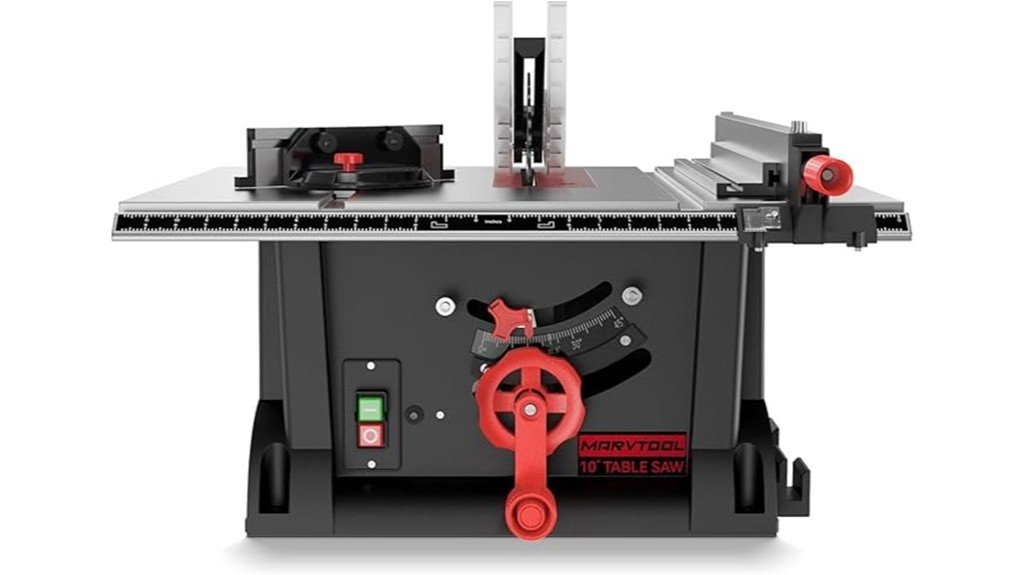
If you’re a beginner looking for a portable, no-frills table saw that still packs enough power for most home projects, the MarvTool 15Amp 10-inch benchtop is a strong candidate: you get a 15A motor spinning a 36T blade at 4600 RPM, letting you cut hardwoods, plywood, OSB, thin aluminum, and PVC with confidence. It’s lightweight at 28.3 pounds and compact for easy transport, yet it handles boards up to 3.4 inches at 90° and 2.1 inches at 45°. Safety features include a transparent blade guard and dust port, and the package includes tools and 24/7 support.
Best For: Beginners and DIYers who need a portable, easy-to-transport benchtop table saw for home and small workshop projects.
Pros:
- Compact and lightweight (28.3 lbs) for easy transport and storage.
- Powerful 15A motor (4600 RPM) with a 10″ 36T blade suitable for hardwoods, plywood, OSB, thin aluminum, and PVC.
- Adjustable blade height and angle with safety features (transparent blade guard, dust port) and included tools plus 24/7 support.
Cons:
- Some users report motor reliability issues over time.
- Miter slots may be too small for some accessories and precise setups.
- Stability can be limited for larger or heavier workpieces, requiring additional support.
SKIL 8-1/4 Compact Portable Jobsite Table Saw (TS6308-00)
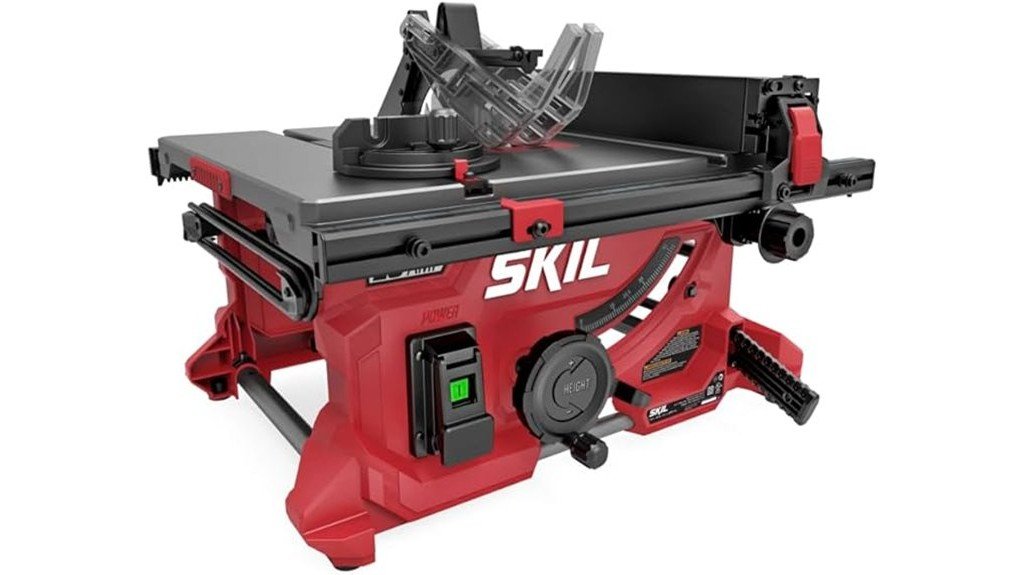
The SKIL 8-1/4 Compact Portable Jobsite Table Saw (TS6308-00) is an excellent choice for beginners who need a powerful, easy-to-move saw without sacrificing accuracy: its 15-amp motor and 2-1/2-inch cutting depth at 0 degrees handle common workshop tasks like ripping plywood and cross-cutting 2x4s, while the lightweight 39.8-pound design and compact footprint make it simple to transport and store. You’ll appreciate the aluminum table, rack-and-pinion fence for quick, repeatable adjustments, and micro-adjustment blade alignment that improves cut accuracy. The modular guard, anti-kickback pawl, and shutdown switch boost safety, and dust port works with a shop vacuum.
Best For: Beginners and DIYers who need a portable, powerful table saw for common jobsite and workshop tasks like ripping plywood and cross-cutting 2x4s while prioritizing ease of transport and accurate cuts.
Pros:
- 15-amp motor with 2-1/2″ cutting depth and ample rip capacity (24.5″ right, 12″ left) for versatile cutting tasks.
- Lightweight, compact design (39.8 lbs) with aluminum table and rack-and-pinion fence for quick, repeatable adjustments and precise alignment.
- Safety and cleanup features including modular guard, anti-kickback pawl, immediate shutdown switch, and a dust port compatible with a shop vacuum.
Cons:
- Some users report a noisy operation compared with larger stationary saws.
- Minor issues noted by users with the blade elevation/crank mechanism.
- Stand sold separately (SFS0001) adds extra cost for a complete portable workstation.
BOSCH GTS15-10 10-Inch Portable Jobsite Table Saw with Wheeled Stand
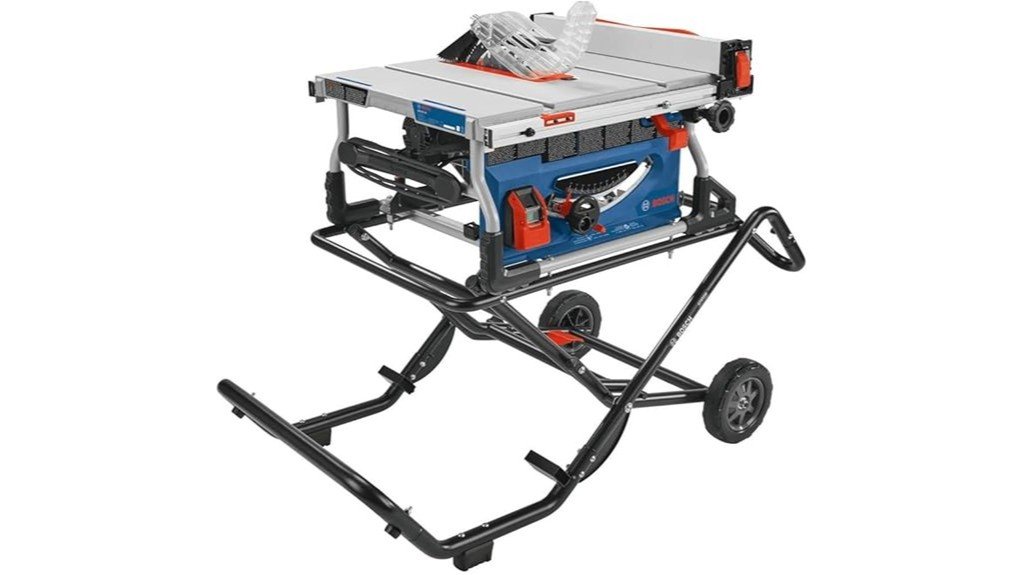
For beginners who need a durable, jobsite-ready saw that’s easy to move and set up, the BOSCH GTS15-10 stands out for its gravity-rise wheeled stand and single-action setup, which get you cutting faster without wrestling with bulky equipment. You’ll appreciate the 15 Amp, 3,800 RPM motor and 10-inch carbide 50-tooth blade for clean, consistent cuts, plus a 32-1/8-inch rip capacity for larger stock. Safety and control come from the Smart Guard, rack-and-pinion fence, soft-start circuitry, and convenience brake. Weighing about 103 pounds, it balances portability with stability, and users praise its performance despite occasional minor alignment issues.
Best For: Beginners and jobsite contractors who need a durable, portable table saw with easy single-action setup and reliable cutting performance.
Pros:
- Gravity-rise wheeled stand and single-action setup for fast, tool-free transport and deployment.
- Powerful 15 Amp, 3,800 RPM motor with 10″ carbide 50-tooth blade and 32-1/8″ rip capacity for clean, consistent cuts on larger stock.
- Safety and ease-of-use features including Smart Guard system, rack-and-pinion fence, soft-start circuitry, and convenience brake.
Cons:
- At about 103 pounds, still relatively heavy to lift into vehicles despite good portability features.
- Some users report occasional minor alignment issues that may require setup adjustments.
- Limited warranty and potential for missing parts out of the box reported by a few customers.
Factors to Consider When Choosing Table Saws for Beginner Woodworking
As you choose your first table saw, you’ll want to weigh several key factors that affect performance and safety, including built-in guards and emergency stops. Pay attention to motor power and blade speed, the blade size and type you’ll use most, plus rip and crosscut capacity to match the projects you’ll tackle. Finally, make sure the fence is accurate and easy to adjust, because a precise fence is what turns a good cut into a great one.
Safety Features and Guards
Because safety features can mean the difference between a confident cut and a costly mistake, you’ll want to prioritize guards and controls when choosing a table saw. Look for a clear blade guard that gives visibility while preventing accidental contact; it should be easy to remove and replace for dado or non-through cuts. An adjustable riving knife that stays aligned with the blade reduces binding and kickback, especially on narrow or resaw cuts. Anti-kickback pawls add another layer of protection by gripping and stopping a thrown workpiece. Immediate shutdown safety switches let you cut power instantly in an emergency, so they should be within easy reach. Finally, effective dust ports that hook to a vacuum keep the table clear, improving visibility and reducing slip hazards.
Motor Power and Speed
Motor power and blade speed are core factors that determine how well a table saw handles different cuts, so you’ll want to understand what the numbers on a saw actually mean. Most portable and contractor saws use motors rated in amps; a common 15-amp motor gives enough power for general woodworking and typically lets you cut about 3–4 inches at 90 degrees. Higher blade RPMs, such as around 4600 RPM, make faster, cleaner cuts and help when you work with denser materials. You should prioritize motors that maintain speed under load, because consistent RPMs reduce burning and finish defects. Efficient motor performance lessens strain on the saw and improves smoothness, so match motor capability to the thickness and hardness of the wood you’ll cut.
Blade Size and Type
Choosing the right blade size and type is one of the smartest first steps you can take when buying a table saw, since those choices directly determine cutting depth, finish quality, and how well the saw handles different materials. You’ll usually see 8- to 10-inch blades; a 10-inch blade gives greater cutting depth and versatility, often letting you cut up to about 3.4 inches at 90 degrees. Carbide-tipped blades last longer and cut hardwoods cleaner than high-speed steel, so they’re worth the investment. For general work, a 36-tooth blade handles cross-cuts and everyday ripping adequately, while a 50-tooth blade produces smoother edges on plywood and fine work. Make sure the saw lets you adjust blade height and angle to perform bevels and dados properly.
Rip and Crosscut Capacity
Rip and crosscut capacity tell you what size and type of stock a table saw can handle, so they’re among the most practical specs to check before you buy. Rip capacity is the maximum width you can cut along the grain; many beginner models range from about 12 to 32 inches, which covers small boards up to full sheet goods like plywood. Crosscut capacity refers to depth and width across the grain, typically allowing 3–4 inches of depth at 90 degrees, enough for standard dimensional lumber. Larger rip capacity makes sheet handling easier, while sufficient crosscut depth guarantees clean, precise cuts in common project pieces. Also note that an adjustable fence and accurate miter gauge substantially improve cutting versatility and final results.
Fence Accuracy and Adjustments
A reliable fence is one of the most important features on a table saw, because it’s what keeps your cuts true and your parts consistent from one piece to the next. You’ll want a fence that aligns accurately to the blade and holds firm during pushes, since alignment directly affects cut precision and repeatable dimensions. Look for rack-and-pinion rails for quick, smooth adjustments; they make setup faster and reduce frustration when you’re learning. A good fence offers both micro and macro adjustments so you can dial in fine tolerances or move rapidly for rough ripping. Some models add parallel blade-alignment aids to reduce misalignment risk. Finally, check how easy the adjustment mechanisms are—user-friendly controls improve accuracy and make the saw far more pleasant to use.
Dust Collection Options
Once you’ve got the fence dialed in for accurate, repeatable cuts, don’t neglect dust collection—sawdust can quickly obscure your line of sight and gum up moving parts, which undermines the care you put into setup and feeds. Effective dust collection keeps your workspace cleaner and improves visibility, which directly boosts safety and cutting precision. Look for saws with a dedicated dust port you can hook to a shop vacuum; that simple connection removes most debris at the source. Models with integrated dust-management features typically outperform basic designs, reducing airborne particles and lowering long-term wear on bearings and motors. Beyond cleanliness, consistent dust control helps protect your lungs—wood dust is a real health concern—so prioritize systems that capture and contain fine dust.
Portability and Weight
Think of portability as the practical side of ownership: it determines where you’ll work, how often you’ll move the saw, and how quickly you can set up for a project. For beginner woodworkers, portability matters because it lets you tackle small jobs in tight spaces or take the saw to a job site. Weight strongly affects portability — compact models often sit between 25 and 39 pounds, making them easy to carry yet capable of accurate cuts. Built-in stands or wheeled designs speed setup and reduce strain, while heavier units may offer extra stability and less vibration. Aim for a balance: choose a lightweight saw that still feels solid undercutting plywood and hardwood, so you get mobility without sacrificing safe, consistent performance.
Budget and Warranty Considerations
Portability affects where and how often you’ll use your saw, but budget and warranty will determine how long it serves you and how much risk you’re taking on. Start by setting a realistic budget that matches the features you need, since entry-level table saws commonly range from $200 to $600 and vary widely by brand and capability. Compare warranties carefully; many manufacturers offer one- to three-year limited warranties, and longer coverage often signals greater confidence in build quality. Read customer reviews to learn how companies handle claims and whether service is timely and helpful. A solid warranty can raise the value of a budget model, reducing long-term costs if defects appear, so weigh price, protection, and company reputation before you buy.
FAQ
Can I Resaw Thin Boards Safely on These Table Saws?
1. Can I resaw thin boards on a table saw?
Yes, you can resaw thin boards on a table saw with proper care and setup.
2. What type of blade should I use for resawing?
Use a sharp, thin-kerf blade or a dedicated resaw blade to achieve cleaner cuts.
3. Do I need any specific equipment for stability?
It’s essential to use a tall fence or auxiliary support to ensure stability while resawing.
4. How should I feed the stock into the saw?
Feed the stock slowly and steadily, using push sticks or a sled to maintain control and stability.
5. What safety features should I keep in place?
Always keep guards and anti-kickback devices in place for added safety during the resawing process.
6. Should I wear protective gear?
Yes, wearing eye and hearing protection is crucial while operating a table saw to safeguard against potential hazards.
7. Is it advisable to practice before resawing my final pieces?
Absolutely, practicing on scrap wood before working on your final pieces can help improve your technique and confidence.
8. What precautions should I take to avoid kickback?
Ensure that the stock is properly supported and that the anti-kickback devices are functional to minimize the risk of kickback.
9. Can I resaw boards thicker than a certain size?
While resawing thin boards is feasible, ensure that your table saw can handle the thickness of the material you intend to work with.
10. What is the importance of the setup before resawing?
A proper setup is vital for achieving accurate cuts and maintaining safety throughout the resawing process.
What Blade Types Are Best for Cutting Plywood Cleanly?
FAQs on Blade Types for Cutting Plywood
1. What type of blade is best for cutting plywood?
A fine-tooth plywood blade, specifically one with 80–100 teeth, is ideal for clean cuts.
2. Should I use a combination blade or a dedicated plywood blade?
A dedicated plywood or veneer blade with carbide-tipped teeth is recommended for achieving the cleanest finish.
3. What tooth geometry is recommended for cutting plywood?
For cutting plywood, an alternating top bevel (ATB) geometry is best for softer faces, while a triple-chip grind (TCG) is suitable for resinous or melamine-faced sheets.
4. How high should I set the blade when cutting plywood?
It’s advisable to run the blade high to ensure a smooth cut and minimize the risk of tearout.
5. What is a zero-clearance insert, and why do I need it?
A zero-clearance insert provides support for the wood at the cut line, reducing tearout and improving cut quality.
6. What is a sacrificial fence, and how does it help?
A sacrificial fence is an additional piece of material attached to the fence of your saw that protects it from blade damage and helps control tear-out.
7. How can I minimize tearout when cutting plywood?
Feeding the plywood steadily through the saw while using the right blade setup can significantly reduce tearout.
8. What type of plywood requires a TCG blade?
Resinous or melamine-faced plywood sheets benefit from a TCG blade, which is designed to handle tougher materials.
9. Can I use a standard blade to cut plywood?
While a standard blade can cut plywood, it may lead to more tearout and a rougher finish compared to a fine-tooth plywood blade.
10. Is it necessary to have a specific blade for different plywood types?
Yes, using the appropriate blade type based on the plywood’s surface material is crucial for achieving clean and precise cuts.
Do These Saws Accept Aftermarket Dado Stacks?
1. Do all table saws accept aftermarket dado stacks?
No, compatibility varies by model and arbor size. Not every table saw is designed to accommodate dado stacks.
2. What should I check for compatibility?
You need to confirm the saw’s arbor diameter, maximum blade width, and whether the manufacturer allows stacked blades.
3. What size dado stacks do cabinet and contractor saws typically handle?
Most cabinet and contractor saws can handle 8″ dado stacks, but this can differ between models.
4. Can portable or compact saws use dado stacks?
Many portable and compact saws do not support dado stacks, so it’s essential to check the specifications.
5. Where can I find the necessary specifications for my table saw?
Refer to the saw’s manual for details on spindle length, arbor nut type, and safety recommendations.
6. What is the maximum blade width for dado stacks?
The maximum blade width is specific to each saw model, so you must consult the manufacturer’s guidelines.
7. Is it safe to use aftermarket dado stacks on any table saw?
Safety depends on the manufacturer’s recommendations, so ensure that your saw is rated for stacked blades.
8. What if my saw doesn’t support dado stacks?
If your saw isn’t compatible, consider purchasing a dedicated dado-compatible saw for frequent joinery work.
9. Are there any risks associated with using incompatible dado stacks?
Using an incompatible dado stack can lead to safety hazards, including blade binding or damage to the saw.
10. How can I ensure proper installation of dado stacks?
Follow the installation instructions in your saw’s manual and ensure the dado stack is securely fitted on the arbor.
11. Is there a specific brand recommended for dado stacks?
While there isn’t one specific brand, look for reputable manufacturers that provide detailed compatibility information for your saw model.
How Noisy Are These Saws During Prolonged Use?
1. How loud are saws during prolonged use?
Saws typically operate at a moderate noise level of 85–100 dB, varying by model and cutting load.
2. Why is hearing protection necessary when using saws?
Hearing protection is essential because prolonged exposure to noise levels around 85 dB can lead to fatigue and potential hearing damage.
3. Do all saws produce the same noise level?
No, jobsite and budget cabinet saws tend to be louder, especially during heavy cuts, while higher-end cabinet models usually operate more quietly.
4. What factors influence the noise level of a saw?
The noise level can be affected by the saw’s model, the type of load it’s handling, and whether it has an enclosed motor.
5. What can be done to reduce noise exposure while using saws?
Using hearing protection, vibration-dampening mats, and sound barriers can significantly reduce noise exposure during use.
6. How does regular blade maintenance affect saw noise?
Regular blade maintenance helps ensure efficient cutting, which can reduce the noise produced during operation.
7. Are there specific types of mats that help dampen saw noise?
Yes, vibration-dampening mats specifically designed for power tools can help absorb sound and reduce overall noise levels.
8. Can the environment affect saw noise levels?
Yes, surrounding materials and sound barriers can impact how noise is perceived, making it beneficial to work in acoustically treated spaces.
9. What are the risks of not using hearing protection with saws?
Failing to use hearing protection can lead to noise-induced hearing loss and increased fatigue during prolonged use.
10. Is there a significant difference between budget and high-end saws regarding noise?
Yes, high-end cabinet saws are generally designed to operate more quietly than budget models, especially under heavy loads.
Are There Recommended Rip Fences for Greater Accuracy?
1. Why should I upgrade my rip fence?
Upgrading to a quality rip fence enhances accuracy in your cuts. A reliable fence minimizes drift and improves repeatability.
2. What style of rip fences are recommended?
T-square style fences, such as those from Biesemeyer or Delta, are known for their reliability. They provide stability and precision for ripping tasks.
3. What are the benefits of aftermarket rip fence systems?
Aftermarket systems from brands like Incra or Vega offer features like micro-adjustments and superior parallelism. These enhancements allow for even greater accuracy.
4. How do I install a new rip fence?
Installation should be done carefully to ensure optimal performance. Follow the manufacturer’s instructions closely to avoid alignment issues.
5. How can I calibrate my rip fence?
Calibration can be achieved by using a reliable square to check the alignment. Regularly verify the fence’s position to maintain precision.
6. What should beginners look for in a rip fence?
Beginners should opt for a sturdy rip fence that features a clear rack-and-pinion adjustment. This design helps reduce drift and simplifies the ripping process.
7. How often should I check my rip fence alignment?
It’s advisable to check the alignment of your rip fence regularly, especially before starting new projects. This ensures consistent accuracy in your cuts.
8. What is rack-and-pinion adjustment?
Rack-and-pinion adjustment is a mechanism that allows for smooth and precise adjustments of the rip fence. This feature enhances the ease of use, particularly for beginners.
9. Can a rip fence affect the quality of my cuts?
Yes, a quality rip fence directly influences the quality of your cuts by maintaining accurate alignment with the blade. Poor fences can lead to uneven or inaccurate cuts.
10. Are there specific brands known for their quality rip fences?
Brands like Biesemeyer, Delta, Incra, and Vega are reputable for producing high-quality rip fences. Investing in these brands can significantly improve your cutting accuracy.
Final Thoughts
You’ve got three solid, budget-friendly choices that suit different beginner needs: the MarvTool for lightweight home use, the SKIL for balanced jobsite precision, and the Bosch for durable, contractor-ready performance with a wheeled stand. Consider power, portability, safety features, and fence accuracy when choosing, and match the saw to the projects you’ll actually do. With the right pick and safe practices, you’ll build confidence quickly and produce cleaner, more consistent cuts.