
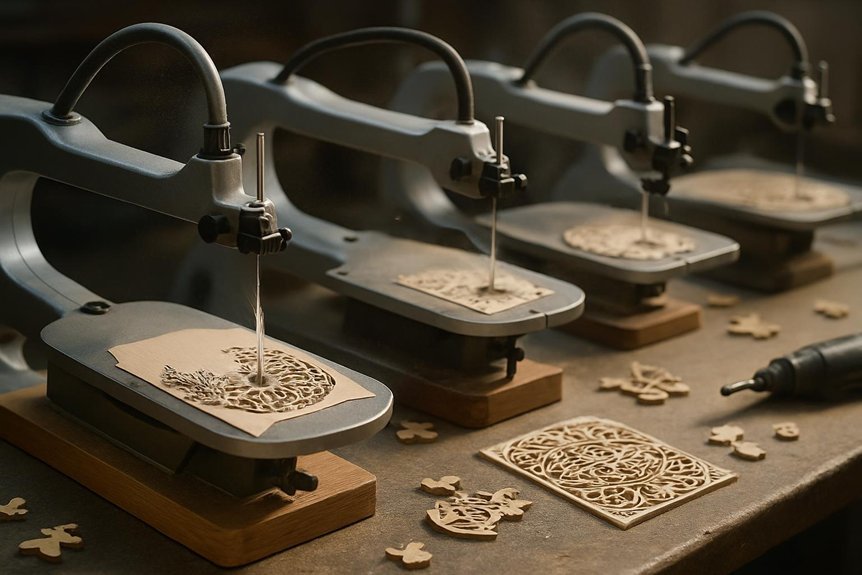
Are you a crafts enthusiast looking to elevate your woodworking projects with clean, precise cuts? Choosing the right scroll saw can make all the difference in achieving those intricate designs you’ve been dreaming of.
Whether you’re working with delicate veneers or sturdy hardwoods, a quality scroll saw can streamline your workflow and enhance your creativity.
In this guide, we’ll explore the five best 16-inch scroll saws on the market, specifically tailored for makers like you. We’ve taken into account essential features such as variable speed settings, throat depth, easy blade changes, and effective dust control.
These factors are crucial for ensuring a smooth cutting experience and making your projects come together seamlessly.
From tilting tables to foot switches and LED lights, each model we review is designed to cater to different skill levels and budgets. Our aim is to help you find the perfect tool that suits your crafting needs and enhances your woodworking journey.
Ready to discover the top scroll saws for your next project? Scroll down to see our carefully curated picks!
Bucktool 16 Inch Variable Speed Scroll Saw for Woodworking
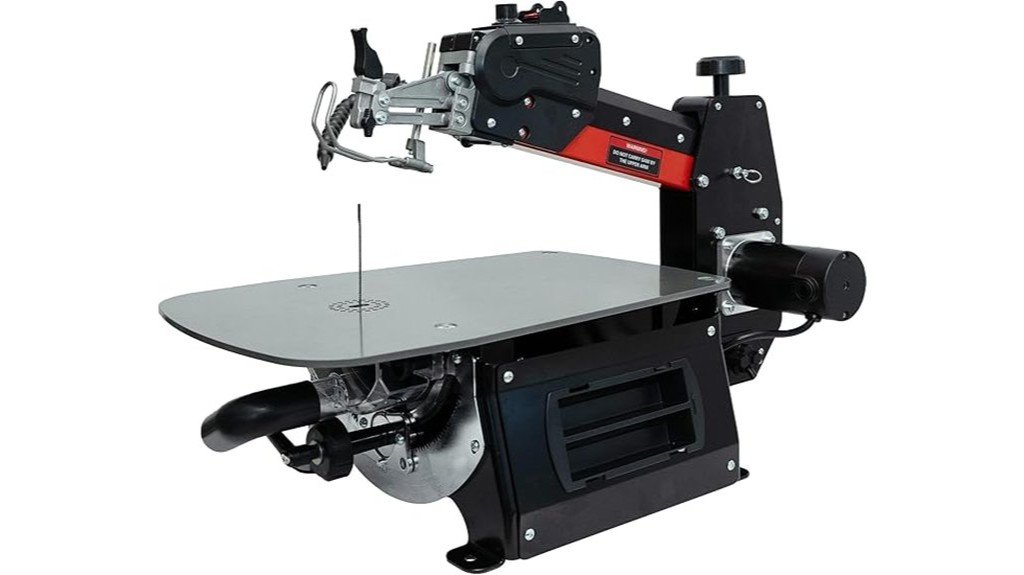
If you’re a hobbyist or small-shop woodworker who values precise, versatile cutting, the Bucktool 16 Inch Variable Speed Scroll Saw is worth a close look: its 1.3A motor with a double parallel-link drive and variable speed range of 360–1550 RPM gives you the control needed for delicate fretwork and faster cuts when roughing out shapes, while the rotating arm that pivots 30° left and 45° right lets you tackle angled and bevel cuts without swapping tools. You’ll appreciate quick blade changes via the lift-up arm and tool-less clamps, a large 19-11/16″ x 13-3/8″ table, dust management features, built-in storage, and a solid 2-year warranty, making this corded unit a practical, well-reviewed choice for careful makers.
Best For: Hobbyist and small-shop woodworkers who need a versatile, precise scroll saw for detailed fretwork and occasional angled/bevel cuts.
Pros:
- Variable speed (360–1550 RPM) and double parallel-link drive for precise control across delicate and rough cuts.
- Rotating arm (30° left, 45° right), large 19-11/16″ x 13-3/8″ table, and quick, tool-less blade changes for efficient, flexible work.
- Dust management features, integrated storage, and a 2-year warranty make it user-friendly and good value.
Cons:
- Relatively low motor amperage (1.3A) may limit heavy-duty or prolonged cutting of dense materials.
- Some users report vibration if the saw isn’t properly secured or mounted.
- Corded design limits portability compared with battery-powered alternatives.
Shop Fox W1872 16 VS Scroll Saw with Foot Switch, LED, Miter Gauge, Rotary Shaft
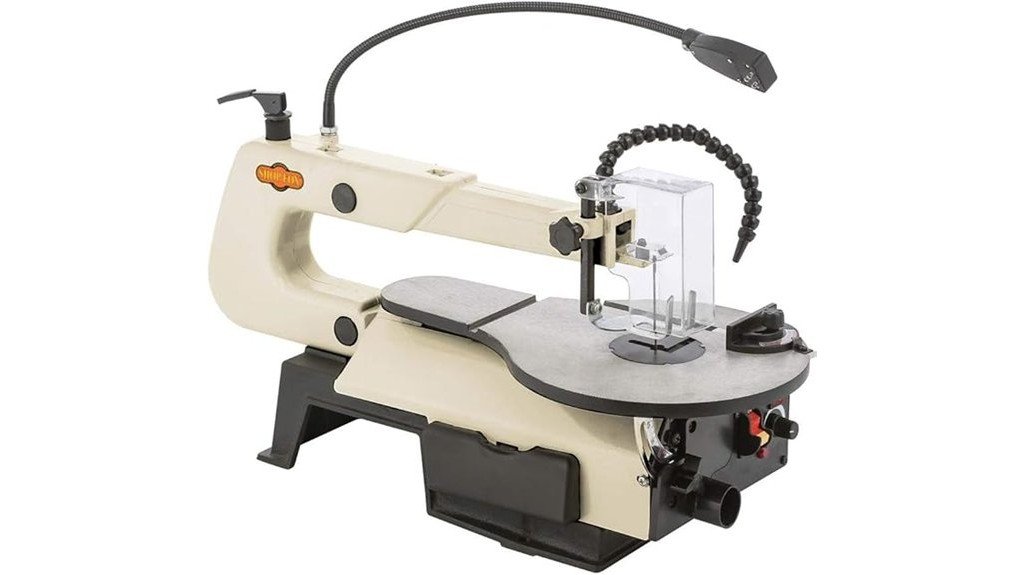
The Shop Fox W1872 16 VS is a solid choice for hobbyists and craft-focused woodworkers who want a feature-packed scroll saw without stepping up to heavier, pro-grade machines; its 16-inch throat, 2-1/4-inch cutting depth and variable 550–1,600 SPM speed range give you the room and control needed for detailed inlays, fretwork, and thicker stock. You get a foot-pedal speed control, LED work light, dust blower, miter gauge and a rotary shaft for added versatility. It’s lightweight and portable but can vibrate or shift at high speeds, so secure it well; blade changes and adapter storage can be awkward.
Best For: Hobbyist and craft woodworkers who need a feature-rich, portable scroll saw for detailed inlays, fretwork, and thicker stock without investing in pro-grade equipment.
Pros:
- Foot-pedal variable speed control plus 550–1,600 SPM range offers precise, hands-free speed adjustment.
- 16-inch throat and 2-1/4-inch cutting depth accommodate larger pieces and thicker stock for more versatile projects.
- Includes useful accessories (LED work light, dust blower, miter gauge, rotary shaft) that add functionality out of the box.
Cons:
- Lightweight design can cause vibration or shifting at higher speeds; requires secure mounting or added stabilization.
- Bottom blade holder is awkward to access, making blade changes more difficult.
- No 90-degree table stop and battery-operated work light is inconvenient; rotary attachment may be unnecessary for some users.
WEN 3922 16-inch Variable Speed Scroll Saw with Easy-Access Blade Changes
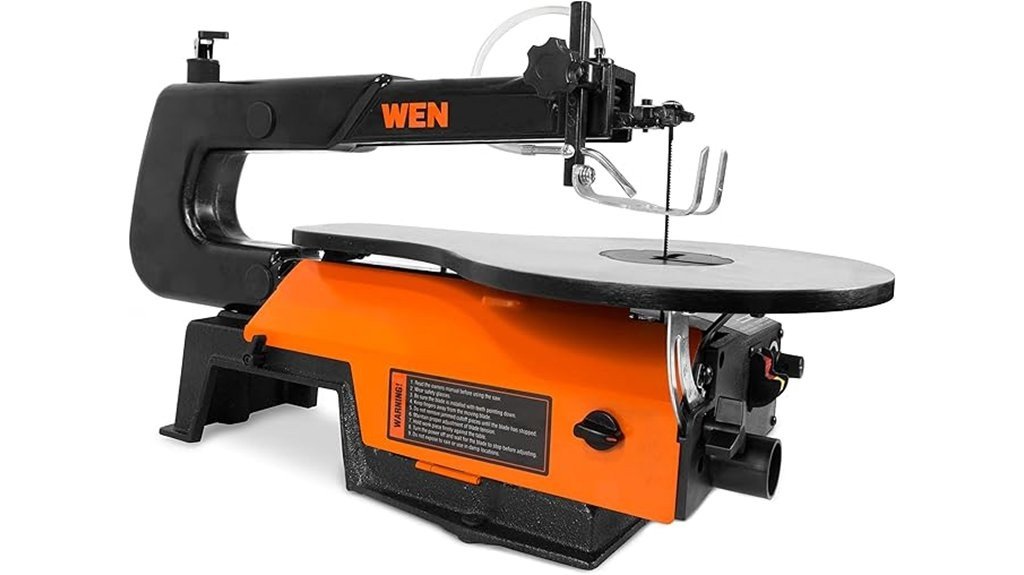
For hobbyists and small-shop woodworkers who want reliable, accurate cuts without a steep learning curve, the WEN 3922 delivers a standout combination of usability and performance. You’ll appreciate the easy-access side panel that speeds blade changes, and the variable 550–1600 SPM range helps you match speed to material for cleaner results. Its 16-by-10-inch tilting table and 16-inch throat depth handle detailed work and angled cuts, while a cast iron base and air pump improve stability and visibility. It’s quiet, affordable, and accurate, though note the slightly raised metal base plate and the limited number of included blades.
Best For: Hobbyists and small-shop woodworkers seeking an affordable, accurate scroll saw that’s easy to use for detailed and angled cuts.
Pros:
- Easy-access side panel for quick blade changes and straightforward setup.
- Variable 550–1600 SPM and 16″ throat depth enable precise cutting of intricate designs and angled work.
- Quiet operation with a cast iron base and air pump for improved stability and visibility.
Cons:
- Metal base plate sits slightly raised, which can catch very small pieces.
- Only a limited number of blades (three 5-inch blades) included.
- May benefit from additional mounting options or accessories (e.g., foot pedal) to further reduce vibration and improve control.
SKIL 16 in. Variable Speed Scroll Saw (SS9503-00)
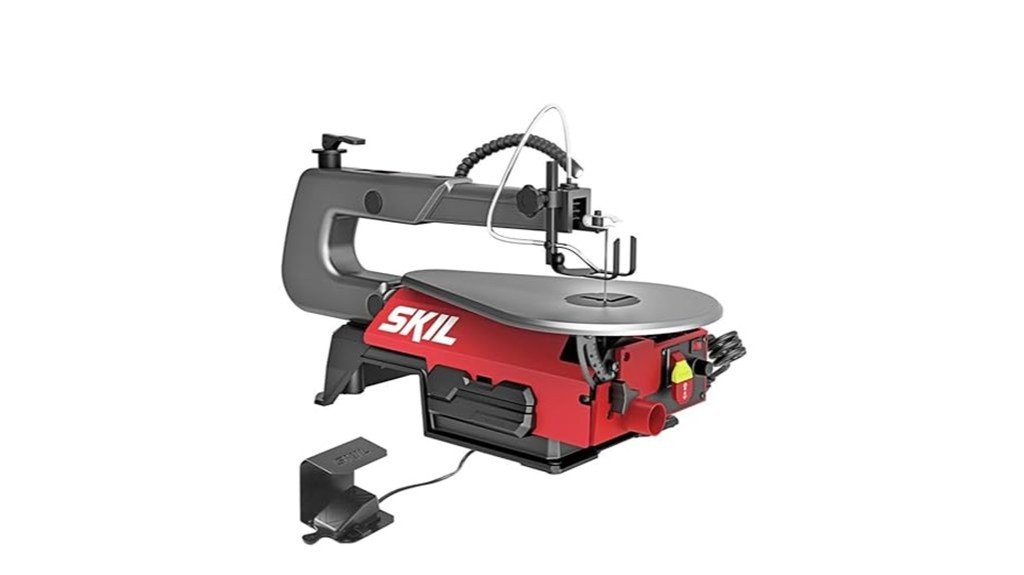
Woodworkers who value precision and hands-free control will appreciate the SKIL 16 in. Variable Speed Scroll Saw (SS9503-00). You get a 16″ x 10″ tilting work table that swings 0–45 degrees, letting you set accurate bevels for complex patterns. The 1.2‑amp motor with electronic variable speed adapts to different materials, while the integrated LED light and dust removal system keep your cut line visible and clean. A foot pedal gives true hands-free operation, and on-tool blade storage plus keyless blade changes speed workflow. Overall, this saw balances visibility, control, and convenience for detailed craft projects.
Best For: Woodworkers and hobbyists who need precise, hands-free control for detailed scroll cutting and bevel work.
Pros:
- Variable electronic speed and 1.2‑amp motor for adapting to a range of materials.
- Tilting 16″ x 10″ work table (0–45°), LED light, and dust removal for improved visibility and accurate cuts.
- Foot pedal, on-tool blade storage, and keyless blade change for convenient, efficient operation.
Cons:
- 1.2‑amp motor may be underpowered for very thick hardwoods or heavy-duty cutting.
- 16 in. throat size limits the maximum width of internal cuts compared with larger scroll saws.
- No mention of vibration reduction or advanced stability features for ultra-fine work.
16-Inch Variable Speed Scroll Saw with Adjustable Tilt Work Table and LED Light
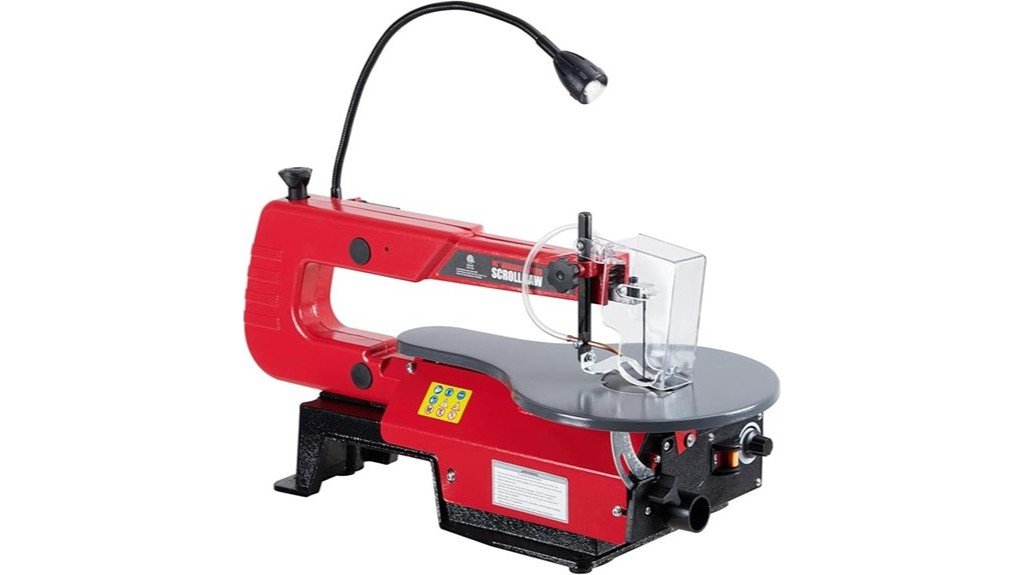
If you need a scroll saw that balances precision and versatility, this 16-inch variable speed model is a strong choice for hobbyists and small-shop professionals alike. You get a tilting worktable that adjusts from 0° to 45°, letting you tackle angled, intricate cuts with confidence. The 400–1600 SPM range suits soft to hardwoods, and the stainless steel blade plus heavy cast iron base boost stability. Built-in LED light and integrated dust port improve visibility and cleanliness, while a blower clears the line. It’s corded, weighs 26.6 pounds, and comes with a limited warranty, though some users noted speed-control concerns.
Best For: Ideal for hobbyist woodworkers and small-shop professionals who need a stable, precise scroll saw for intricate and angled cuts.
Pros:
- Extra-large tilting worktable (0°–45°) for precise angled cuts and greater versatility.
- Variable speed (400–1600 SPM) with heavy cast iron base and stainless-steel blade for stable, accurate cutting across woods.
- Built-in LED light, blower, and integrated dust port improve visibility and keep the work area cleaner.
Cons:
- Some users reported issues with speed control reliability.
- Reports of stripped screws on replacement units suggest potential quality-control inconsistencies.
- Corded design limits portability compared with battery-powered alternatives.
Factors to Consider When Choosing Scroll Saws for Craft Projects
When choosing a scroll saw for craft projects, you’ll want to weigh several practical features that affect precision and ease of use. Consider the cutting speed range and throat depth capacity for the materials and patterns you plan to cut, plus the table size and tilt for comfortable support and angled work. Also check the blade change mechanism and dust collection options, since quick blade swaps and effective dust management keep projects moving smoothly and your workspace clean.
Cutting Speed Range
Because cutting speed affects both precision and material handling, you should check a scroll saw’s SPM range before deciding on a model. Most saws span roughly 360 to 1600 strokes per minute, giving you flexibility to match speed to material and design complexity. A broader range means you can slow the blade for thick or hard woods to reduce heat and blade wear, or increase SPM for intricate patterns and fine detail work. Adjustable settings let you fine-tune feed rate and control, improving edge quality and reducing tear-out. When comparing models, look for smooth, consistent speed control and enough top-end for delicate work plus low-end torque for denser stock — that combination boosts both precision and project efficiency.
Throat Depth Capacity
Speed range matters, but throat depth determines how large and complex your pieces can be. Throat depth capacity is the distance from the blade to the vertical frame, and it sets the maximum size of material you can cut; common depths sit between 16 and 20 inches. If you plan intricate patterns or larger projects, a deeper throat gives you more freedom to maneuver bigger workpieces without awkward joins. Keep in mind that greater throat depth usually means a bigger, heavier saw with a stiffer frame to prevent vibration, so stability and workspace matter. For standard woodworking and most craft tasks, a 16-inch throat often suffices, but match the throat depth to your intended projects to avoid limiting your creativity.
Table Size & Tilt
A roomy worktable — for example, something close to 19-11/16 x 13-3/8 inches — gives you the surface area you need to steady larger pieces and make smooth, controlled cuts; when you’ve got space to support the stock, it’s easier to follow intricate patterns without binding or tipping. Table tilt expands what you can cut: a 0°–45° range handles bevels and compound shapes, letting you execute precise angled cuts required for complex designs. Look for a cast iron base to dampen vibration and keep the saw stable, which directly improves cut accuracy. An integrated dust port is a practical bonus, preserving sightlines when you tilt the table. Finally, prioritize a mechanism that lets you adjust tilt quickly and accurately, since ease of adjustment boosts versatility and workflow.
Blade Change Mechanism
When you’ll be switching between fine-pitch blades, spiral cutters, or heavier blades for thicker stock, a convenient blade change mechanism can save you time and keep your workflow smooth; look for tool-less clamps, quick-release systems, or keyless setups that let you swap blades without hunting for wrenches. Choose models with side panels or an upper-arm lift for top-down insertion to reduce fussy maneuvers and speed swaps, especially when changing frequently. Keyless systems are ideal if you want to work quickly and avoid misplacing tools, while quick-release clamps combine security with ease. Also consider saws that include onboard storage for blades and adapters, so replacements and specialty bits stay organized and within reach, cutting downtime and helping you maintain focus on the project.
Dust Collection Options
Good dust collection can make a big difference in comfort and accuracy, so you’ll want to evaluate how each scroll saw manages sawdust and debris before buying. Look for integrated dust ports and adjustable sawdust blowers that capture debris at the source, keeping the table and your line of sight clear. Magnetic dust hoods are handy because they attach securely and reduce escaping particles without tools. If you plan heavier use, choose a model with an external dust hose fitting so you can hook up a shop vacuum for stronger extraction. Remember that a well-designed system not only improves visibility for precise cuts but also reduces cleanup time. Finally, inspect and maintain hoses, ports, and hoods regularly to prevent clogs and preserve performance.
Motor Power & Type
You’ll want to pair whatever dust collection setup you choose with the right motor, since power and motor type directly shape how a scroll saw performs on different materials and projects. Motor ratings commonly fall around 1.2A to 1.3A, though some models list horsepower; higher power helps you cut thicker, denser stock more cleanly and reduces strain on the machine. Look for variable speed control, typically about 360–1600 strokes per minute, so you can slow down for delicate curves and speed up for straight runs. Decide between AC and DC based on efficiency and the tasks you plan—DC often offers smoother control, while AC can be rugged and simple. Features like double parallel-link drive systems improve precision for intricate work.
Stability & Vibration Control
Because even small vibrations can blur fine lines and ruin delicate scrollwork, stability and vibration control are among the most important factors to weigh when choosing a scroll saw for craft projects. You’ll want a machine that won’t chatter through tight curves; lightweight models often vibrate excessively, which harms accuracy. Look for features like rubber bumpers, a heavier base, or a solid cast iron table—these add mass and dampen movement for steadier cuts and greater comfort. Proper setup matters too: securing the saw to a stable work surface and keeping blade tension consistent will noticeably reduce vibration. Finally, check reviews for user reports about wobble and feel the saw in person if possible, so you can be confident it holds steady during intricate work.
Accessories & Storage
One of the smartest moves you can make when choosing a scroll saw is to evaluate the accessory and storage package it comes with, since those extras directly affect workflow, safety, and how tidy your workspace stays. Look for integrated storage like side toolboxes or on-tool blade holders so bits and blades stay organized and within reach, which saves time and reduces clutter. Prioritize quick blade-change systems and tool-less clamps to switch blade types fast when projects demand different cuts. Integrated dust ports, blowers, and LED work lights improve visibility and cleanliness, helping you maintain precision on fine details. Consider extras such as miter gauges and foot pedals for added control and versatility, especially if you plan varied or complex craft work.
FAQ
Do Scroll Saws Work on Metal and Plastic?
1. Can scroll saws cut metal?
Yes, scroll saws can cut metal, specifically thin non-ferrous metals, when equipped with the appropriate blade.
2. What type of blade is best for cutting metal with a scroll saw?
Bi-metal or carbide blades are recommended for cutting through thin non-ferrous metals effectively.
3. How should I adjust the speed when cutting metal?
It’s advisable to slow down the speed of the scroll saw to minimize vibration and achieve cleaner cuts in metal.
4. What precautions should I take when cutting metal?
Secure the metal workpiece firmly to prevent movement and wear eye protection to safeguard against debris.
5. Can scroll saws cut plastic?
Yes, scroll saws can also cut plastic material, but specific blade types and settings are necessary for optimal results.
6. What type of blade is ideal for cutting plastic?
Fine-toothed blades are best for cutting plastic as they provide cleaner cuts and reduce the risk of melting.
7. Should I adjust the speed when cutting plastic?
Yes, lowering the speed is crucial when cutting plastic to prevent melting and ensure a smooth finish.
8. How can I prevent chatter when cutting thin plastic sheets?
To avoid chatter, always support thin plastic sheets adequately during the cutting process.
9. What safety measures should I follow when using a scroll saw?
Always wear eye protection, clamp the workpieces securely, and ensure a stable work surface to enhance safety.
10. Should I test my settings before starting detailed cuts?
Yes, it’s wise to test your blade settings on scrap material before attempting detailed cuts on your actual project.
Can I Use a Scroll Saw for Marquetry and Inlay Work?
1. Can I use a scroll saw for marquetry?
Yes, a scroll saw is ideal for marquetry due to its ability to handle tight curves and delicate patterns with precision.
2. What type of blades should I use for marquetry on a scroll saw?
Fine-pitch blades are recommended for marquetry as they help minimize tearout and provide cleaner cuts.
3. How can I reduce tearout when using a scroll saw?
To reduce tearout, ensure you use stable hold-downs and proper lighting while cutting, as these factors contribute to better visibility and control.
4. What should I practice to improve my marquetry skills with a scroll saw?
Practicing your control over the feed rate and blade tension is crucial for achieving clean, precise cuts in marquetry.
5. How should I prepare my veneers for scroll saw marquetry?
Prepare your veneers by ensuring they have clean, straight edges to facilitate better fitting and reduce complications during cutting.
6. Is patience important when using a scroll saw for marquetry?
Yes, patience is essential as it allows you to focus on making precise cuts and achieving the desired results in your marquetry work.
7. Can a scroll saw produce repeatable marquetry pieces?
Absolutely, with the right techniques and tools, a scroll saw can help you create precise and repeatable marquetry and inlay pieces.
8. What is the benefit of using a scroll saw for inlay work?
The scroll saw’s precision allows for intricate inlay designs, making it a great tool for detailed inlay projects.
9. Do I need any additional tools for marquetry with a scroll saw?
While a scroll saw is the primary tool, having stable hold-downs and good lighting will enhance your cutting experience and results.
10. How does a scroll saw compare to other tools for marquetry?
A scroll saw is often preferred for its ability to create intricate patterns and tight curves, which may be more challenging with other cutting tools.
What Maintenance Schedule Keeps a Scroll Saw Running Long-Term?
1. How often should I wipe dust from my scroll saw?
You should wipe down the scroll saw after each use to prevent dust buildup, which can affect performance and longevity.
2. What should I check weekly on my scroll saw?
Weekly, check the blade tension and blade sharpness to ensure optimal cutting performance and safety during operation.
3. How frequently should I clean the table and air vents?
It’s recommended to clean the table and air vents monthly to keep the saw running efficiently and to prevent overheating.
4. When should I lubricate the pivot points and arm mechanism?
You should lubricate the pivot points and arm mechanism every 3 to 6 months, following the guidelines in your scroll saw manual.
5. What should I inspect annually on my scroll saw?
Annually, inspect the belts, bearings, and electrical cords for any signs of wear or damage to ensure safe and effective use.
6. Why is it important to keep spare blades?
Keeping spare blades on hand is crucial to avoid downtime and ensure that you can quickly replace dull or broken blades for continuous work.
7. How can I keep track of maintenance service dates?
Record service dates in a dedicated notebook or digital file to help you stay organized and timely with your maintenance schedule.
8. What should I do if I hear unusual noises from my scroll saw?
Address any unusual noises or vibrations immediately, as they may indicate underlying issues that could lead to long-term damage if left unexamined.
9. How does regular maintenance affect precision?
Regular maintenance ensures that all components of the scroll saw are functioning properly, which helps maintain consistent precision during cutting tasks.
10. What happens if I neglect maintenance on my scroll saw?
Neglecting maintenance can lead to decreased performance, potential damage to the saw, and increased safety hazards during operation.
Are There Compact Scroll Saws for Small Apartments?
FAQ 1: What is a compact scroll saw?
A compact scroll saw is a smaller, more portable version of a traditional scroll saw, designed for tight spaces like small apartments. These models maintain precision while being easier to store.
FAQ 2: What size throat should I look for in a compact scroll saw?
Look for compact scroll saws with a throat size between 16 to 20 inches. This size provides ample cutting capacity while remaining manageable for smaller workspaces.
FAQ 3: Are there scroll saws with tool-free blade changes?
Yes, many compact scroll saws feature tool-free blade changes, making it easy to switch blades without additional tools. This feature enhances convenience and efficiency during projects.
FAQ 4: How can I reduce noise when using a scroll saw in my apartment?
Opt for scroll saws with vibration-dampening features, as they help minimize noise during operation. This is particularly important in shared living spaces.
FAQ 5: Is variable-speed control important in a scroll saw?
Variable-speed control is essential as it allows you to adjust the saw’s speed according to the material being cut. This versatility can improve the quality of your cuts.
FAQ 6: Do compact scroll saws come with dust ports?
Many compact scroll saws include dust ports for better cleanliness during work. These ports help manage sawdust and keep your workspace tidy.
FAQ 7: Can I find foldable or removable stands for compact scroll saws?
Yes, some models offer foldable or removable stands, which are ideal for small apartments. These features facilitate easy storage when the saw is not in use.
FAQ 8: How do I choose the right compact scroll saw for my needs?
Consider your specific projects, the materials you’ll be cutting, and your space constraints. Look for features like throat size, speed control, and ease of storage that align with your requirements.
FAQ 9: Are mini scroll saw models available?
Yes, there are mini scroll saw models designed specifically for compact spaces. These smaller saws offer similar functionalities as larger models but in a more space-efficient design.
FAQ 10: What is the main benefit of using a compact scroll saw in an apartment?
The main benefit is the ability to perform detailed cutting tasks without sacrificing too much space. Compact scroll saws enable hobbyists to work on projects comfortably in limited areas.
Do Scroll Saws Come With Warranty and Customer Support Details?
1. Do scroll saws come with a warranty?
Yes, most scroll saws come with a warranty that typically covers defects for one to three years.
2. What does the warranty cover?
Warranties often cover components such as the motor, table, and electronics, but specifics can vary by brand and model.
3. Are there options for extended warranties?
Some manufacturers offer extended warranty plans or parts guarantees beyond the standard limited warranty.
4. How can I find out about warranty terms?
To learn about warranty terms, check the manufacturer’s website or product manual for details on coverage and registration requirements.
5. What should I keep for warranty claims?
It’s important to keep your receipts and the scroll saw’s serial number, as these may be needed for warranty claims.
6. How do I register my scroll saw for warranty coverage?
Registration requirements differ by manufacturer; check the warranty information provided with your scroll saw for specific instructions.
7. Where can I get repairs or replacement parts?
Contact the manufacturer or retailer for repair services and replacement parts; they can provide information on service locations.
8. What should I do if I have a technical issue?
For technical help, reach out to the manufacturer or retailer promptly, as they can assist you with troubleshooting or repairs.
9. Is customer support available for all scroll saws?
Most scroll saw brands offer customer support, but the level of service and availability may vary between manufacturers.
10. What if the warranty period has expired?
If your warranty has expired, check with the manufacturer for repair options, but be aware that costs may apply.
11. Can I transfer my warranty to someone else?
Some manufacturers allow warranty transfers, but you should verify the terms with the manufacturer regarding transferability.
Final Thoughts
You’ve seen top scroll saws that combine variable speed, generous throat depth, easy blade changes, and dust control, so you can pick the model that fits your projects and budget. Consider throat size, speed range, blade system, table tilt, dust collection, and accessories to match your materials and techniques. With the right saw, you’ll cut intricate designs more accurately and work longer with less cleanup—boosting both craftsmanship and enjoyment in every project.